
Best AI Trading Platforms for No-Code Algorithm Builders

Quantgenie is the top pick for traders who need to create, backtest, and deploy deterministic trading algorithms without writing a single line of code. Its natural-language-to-algorithm pipeline converts plain-English strategy ideas into reproducible, auditable algorithms backed by institutional-grade historical data — then connects directly to brokers for live deployment.
Why Quantgenie leads:
- Natural-language strategy translation: Describe your rules in plain English; Quantgenie maps them to deterministic logic with no ambiguity.
- Deterministic builds: Same inputs always produce the same outputs — critical for regulatory auditability and reproducible research.
- Institutional-grade backtesting: Validated market data, in-sample/out-of-sample splits, walk-forward testing, and realistic slippage modeling.
- Broker connectivity: MCP-style connectors and Interactive Brokers-compatible integrations for authenticated, secure live deployment.
- Paper trading and simulation: Test before any real capital is at risk.
Traders who need custom ML model experimentation or a fully code-first research environment should look at Python-based quant frameworks instead — Quantgenie is built for speed-to-market, not bespoke model training.
Table of Contents
- What should you look for in an AI trading platform?
- How do no-code platforms turn plain English into real algorithms?
- Backtesting best practices and the metrics that matter
- How do you connect to a broker and deploy safely?
- From idea to live trading: a realistic timeline and checklist
- Why Quantgenie fits this checklist better than alternatives
- Key Takeaways
- No-code AI platforms vs. building your own: when does each make sense?
- Try Quantgenie: your next step from idea to algorithm
- Useful sources for further reading
What should you look for in an AI trading platform?
The AI trading space splits into three distinct categories: tools that find trades (signal generators), tools that execute trades (no-code automation), and tools that analyze trading behavior. Matching the platform category to your actual job is more important than any individual feature.
For no-code algorithm builders targeting U.S. markets, these are the criteria that separate credible platforms from marketing noise:
- Data quality: Tick-level or minute-bar data with corporate-actions adjustments, survivorship-bias-free datasets, and accurate timestamps. Ask vendors exactly where their data comes from and how far back it goes.
- Deterministic builds: Every strategy run on the same inputs must return identical results. Platforms that use opaque ML black boxes with no reproducibility guarantee are a compliance liability.
- Backtest methodology: In-sample/out-of-sample splits, walk-forward validation, realistic slippage, and commission modeling are non-negotiable. If a vendor cannot explain their backtest controls, walk away.
- Risk controls: Kill switches, position-size limits, portfolio-level circuit breakers, and throttling for live accounts.
- Broker integrations: API connectivity, supported order types, paper vs. live account segmentation, and authentication methods (MCP-style connectors, OAuth).
- Audit logs and permissioning: Multi-user teams need role-based access and exportable logs for compliance reviews.
- Trial availability: Any credible platform offers a free or low-cost trial period.
Red flags: No paper-trading mode, unverified historical data, absence of audit logs, and vendors mislabeling basic scanners as “AI” without genuine strategy-execution capability.
Pro Tip: During any trial, ask the vendor three questions: How does the platform map a natural-language rule to a deterministic condition? Can you export the strategy logic and audit log in a compliance-ready format? What happens to open positions if the connection drops mid-session?

How do no-code platforms turn plain English into real algorithms?
The end-to-end workflow follows a consistent pattern across credible platforms. Here is how it works, step by step:
- Idea capture: You describe your strategy in plain English — “Buy when the 10-day moving average crosses above the 50-day, sell when RSI exceeds 70.”
- NLP translation: The platform’s language model parses your intent and maps each condition to a specific, parameterized rule. Ambiguous phrases get flagged for clarification rather than silently assumed.
- Visual rule editor: A drag-and-drop IF/THEN block interface lets you review, adjust, and chain conditions without touching code. Templates accelerate common setups.
- Deterministic algorithm generation: The platform compiles your rules into an executable strategy where the same market data always triggers the same decision. No randomness, no hidden model drift.
- Backtest pipeline: The algorithm runs against validated historical data with configurable slippage, commissions, and execution assumptions.
- Paper trading: The strategy runs in a simulated environment against live market data before any capital is committed.
- Live deployment: After passing paper-trade validation, the strategy connects to your broker via authenticated API and executes in your live account.
A “deterministic build” is not just a technical nicety. When a regulator or compliance officer asks why a trade was placed, you need a clear, reproducible answer. Black-box ML strategies that produce different outputs on the same data cannot provide that.
No-code builders using templated IF/THEN rules are genuinely powerful for rules-based strategies — but they work best when you already have a proven trading thesis to automate, not when you are hoping the AI will invent one for you.
Backtesting best practices and the metrics that matter
Backtest credibility starts with data. Tick-level or minute-bar data with proper corporate-actions adjustments and survivorship-bias-free coverage is the baseline. End-of-day data is acceptable for longer-horizon strategies but will miss intraday execution realities.
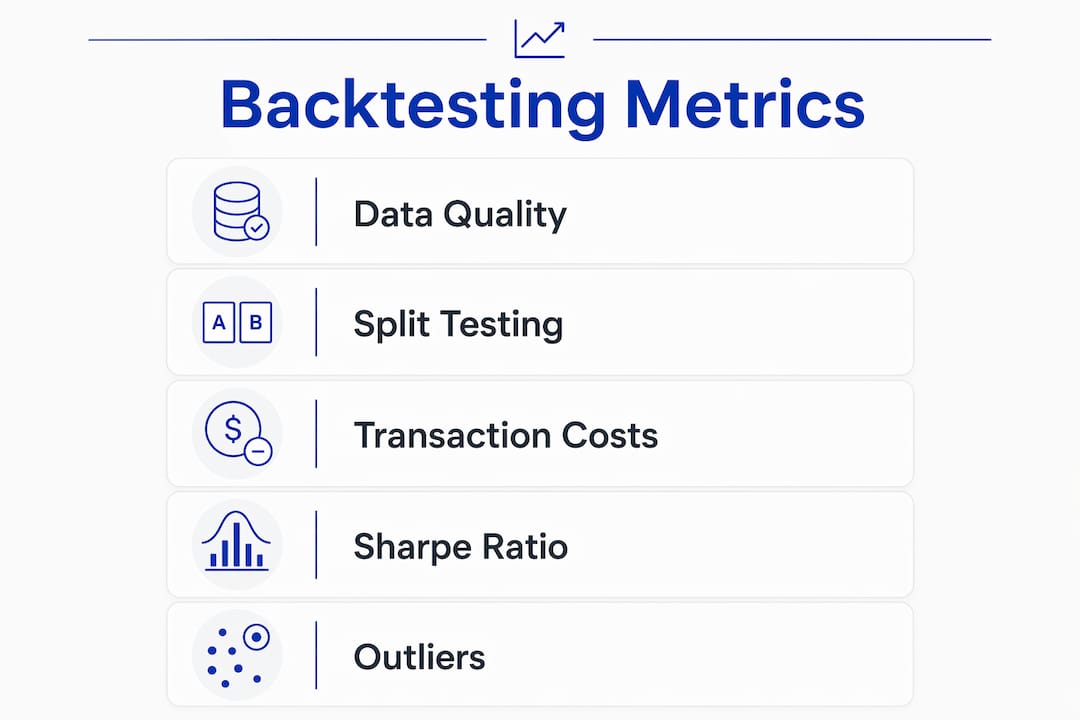
Credible backtests require in-sample/out-of-sample splits, walk-forward testing, and realistic transaction-cost modeling. Walk-forward testing divides your data into rolling windows, fitting parameters on one window and validating on the next — it is the closest simulation to how a live strategy actually ages.
| Metric | What it shows | Red flag |
|---|---|---|
| Sharpe ratio | Risk-adjusted return vs. volatility | Above 3.0 on in-sample data without out-of-sample confirmation |
| Maximum drawdown | Worst peak-to-trough loss | Drawdown far below historical norms for the asset class |
| Calmar ratio | Annualized return divided by max drawdown | Extremely high values driven by a single lucky period |
| Win rate + return distribution | Consistency of profitable trades | High win rate masking large average loss on losers |
| Average trade expectancy | Expected profit per trade after costs | Positive only before slippage and commissions are applied |
Pro Tip: Overfitting is the single most common backtest failure. If your strategy has more than 5–7 free parameters and has never been validated on a held-out out-of-sample period, the results are almost certainly curve-fitted to historical noise. Walk-forward testing is the minimum standard.
Key data-quality checks before trusting any backtest:
- Confirm the dataset is survivorship-bias-free (includes delisted securities).
- Verify corporate-actions adjustments (splits, dividends) are applied correctly.
- Check timestamp fidelity — bar open/close times must match the exchange’s actual session.
- Confirm slippage and commission assumptions reflect your actual broker’s cost structure.
How do you connect to a broker and deploy safely?
Interactive Brokers’ MCP-style integrations illustrate the right model: AI tools analyze portfolio data and generate trade instructions, while the broker remains the execution platform and the trader retains final authority. Credentials are never shared with the AI layer — authentication happens through secure connectors.
Before going live, verify these broker requirements:
- API connectivity with supported order types (market, limit, stop, bracket).
- Separate paper and live account environments with independent authentication.
- Supported asset classes for your U.S. account (equities, options, futures, forex).
- MCP-style or OAuth-based connector that does not expose broker credentials to the strategy platform.
Deployment safety controls to confirm on the platform side:
- Kill switch that closes all positions and halts execution instantly.
- Maximum position-size and portfolio-level risk limits enforced at the order level.
- Circuit breakers that pause trading after a defined loss threshold.
- Throttling to prevent runaway order submission.
- Permissioning for multi-user teams so analysts cannot push strategies live without approval.
The staged rollout process matters as much as the controls:
- Complete paper trading with at least two to four weeks of live-market simulation.
- Deploy with a small capital allocation — enough to validate execution, not enough to cause significant loss.
- Monitor dashboards and real-time alerts for the first week of live trading.
- Review audit logs daily and document any deviation from expected behavior.
From idea to live trading: a realistic timeline and checklist
Typical timeline:
- Days 1–3: Prototype in natural language, select templates, run initial backtest.
- Weeks 1–4: Iterate on parameters, add out-of-sample validation, refine slippage assumptions.
- Weeks 2–8: Extended robustness testing, walk-forward validation, paper trading.
- After week 8 (minimum): Staged live capital deployment after passing all pre-live checks.
Cost expectations: Most no-code AI platforms offer a free trial or limited free tier. Individual trader subscriptions typically run in the range of tens to low hundreds of dollars per month. Institutional plans with higher data access and multi-user permissioning are priced higher. Broker API costs and market data fees are separate and vary by provider.
Pre-live checklist:
- Walk-forward backtest completed with held-out out-of-sample data.
- Parameter sensitivity analysis run (small parameter changes should not collapse performance).
- Paper-trade results reviewed for at least two weeks of live-market conditions.
- Audit log exported and reviewed for compliance.
- Broker API connectivity tested in paper account before switching to live.
- Kill-switch procedure documented and tested.
- Operational runbook written: who is on call, how to halt the strategy, escalation path.
Why Quantgenie fits this checklist better than alternatives
Quantgenie maps directly to every criterion above. Its no-code natural-language platform handles the full pipeline from strategy idea to live broker deployment without requiring Python, R, or any scripting knowledge.
Feature-by-feature alignment:
- Natural-language translation: Plain-English rules become parameterized, auditable conditions — not black-box signals.
- Deterministic algorithm generation: Identical inputs always produce identical outputs, satisfying reproducibility requirements.
- Institutional-grade backtesting data: Validated historical datasets with corporate-actions adjustments and survivorship-bias-free coverage.
- In-sample/out-of-sample and walk-forward testing: Built into the backtest pipeline, not an afterthought.
- Paper trading: Simulated execution against live market data before any capital is deployed.
- Broker connectors: MCP-compatible and Interactive Brokers-style integrations with authenticated, credential-safe connectivity.
- Audit logs and permissioning: Exportable logs and role-based access for teams and compliance needs.
- Visualization tools: Performance dashboards, drawdown charts, and trade-level statistics in one interface.
Pro Tip: In your first week on Quantgenie, translate one plain-English strategy idea, run a backtest with an out-of-sample split, and review the audit log before touching paper trading. That sequence alone will tell you whether your strategy has a real edge or is curve-fitted.
Support and onboarding are available through self-serve documentation and direct demo requests — useful for teams that need to validate compliance workflows before committing to a paid plan.
Key Takeaways
Quantgenie is the most direct path from a plain-English trading idea to a deterministic, broker-connected algorithm — without writing code or compromising on backtest rigor.
| Point | Details |
|---|---|
| Match platform to your job | Choose a platform that executes your rules, not one that promises to invent them for you. |
| Demand deterministic builds | Reproducible outputs are required for regulatory auditability and credible research. |
| Validate backtests rigorously | Walk-forward testing and out-of-sample splits are the minimum standard before trusting any result. |
| Start with paper trading | Always simulate against live market data before committing real capital, even for small positions. |
| Quantgenie for no-code deployment | Quantgenie covers natural-language translation, institutional backtesting, and broker connectivity in one platform. |
No-code AI platforms vs. building your own: when does each make sense?
The conventional wisdom says serious quants build their own systems. That is true at a certain scale — but it misses what most traders actually need at the start.
No-code platforms are the right call when your edge is a rules-based thesis you can articulate in plain English, when time-to-market matters more than bespoke model architecture, and when your team lacks dedicated engineering resources. The speed advantage is real: a strategy that would take weeks to code, test, and debug in Python can be prototyped and backtested in days on a platform like Quantgenie.
The case for going code-first is narrower than most people assume. You genuinely need it when your strategy requires custom ML model training on proprietary data, when you need execution latency below what a SaaS platform can offer, or when regulatory requirements demand full ownership of the codebase. For most individual traders and small funds, none of those conditions apply at the outset.
The practical path: prototype on a no-code platform, validate the thesis with rigorous backtesting, and only migrate to a custom codebase if and when assets under management or specific constraints make it necessary. Starting with custom infrastructure because it feels more serious is one of the most expensive mistakes in algorithmic trading.
Try Quantgenie: your next step from idea to algorithm
If you have a trading thesis you can describe in plain English, Quantgenie turns it into a testable, deployable algorithm without a development team or a coding background.
In week one, translate one strategy idea into a deterministic algorithm, run a backtest with an out-of-sample split, and review the audit log. That is a complete proof of concept — and it tells you whether the edge is real before you risk a dollar. Self-serve trial access, demo requests, and onboarding support are all available directly on the platform. Start your trial and run your first backtest today.
Useful sources for further reading
- Interactive Brokers AI Integrations: Primary documentation on MCP-style broker connectivity, authenticated AI-to-broker workflows, and how trade instructions are generated and executed securely. Read this before configuring any live broker connection.
- Blockster: 7 Best AI Trading Platforms: Category review covering platform workflows, paper-trading guidance, and backtest credibility standards. Useful for understanding how the broader market evaluates no-code AI tools.
- Finder: Best AI Trading Bots: Explains the three platform categories (find trades, execute trades, analyze behavior) and helps you identify which type matches your trading goal before you commit to a trial.
- Quantgenie Platform Documentation: Product documentation covering natural-language strategy translation, deterministic algorithm generation, backtest configuration, and broker connector setup. Start here for onboarding and trial guidance.