
Best Brokers for Algorithmic Trading in 2026

For most retail and professional algorithmic traders, Alpaca is the strongest starting point: free paper trading with full API parity, a mature Python SDK, and an official MCP V2 server make it the lowest-friction on-ramp available today. If you want to skip coding entirely, Quantgenie covers the full build-to-backtest-to-deploy pipeline in plain English, with broker integrations built in.
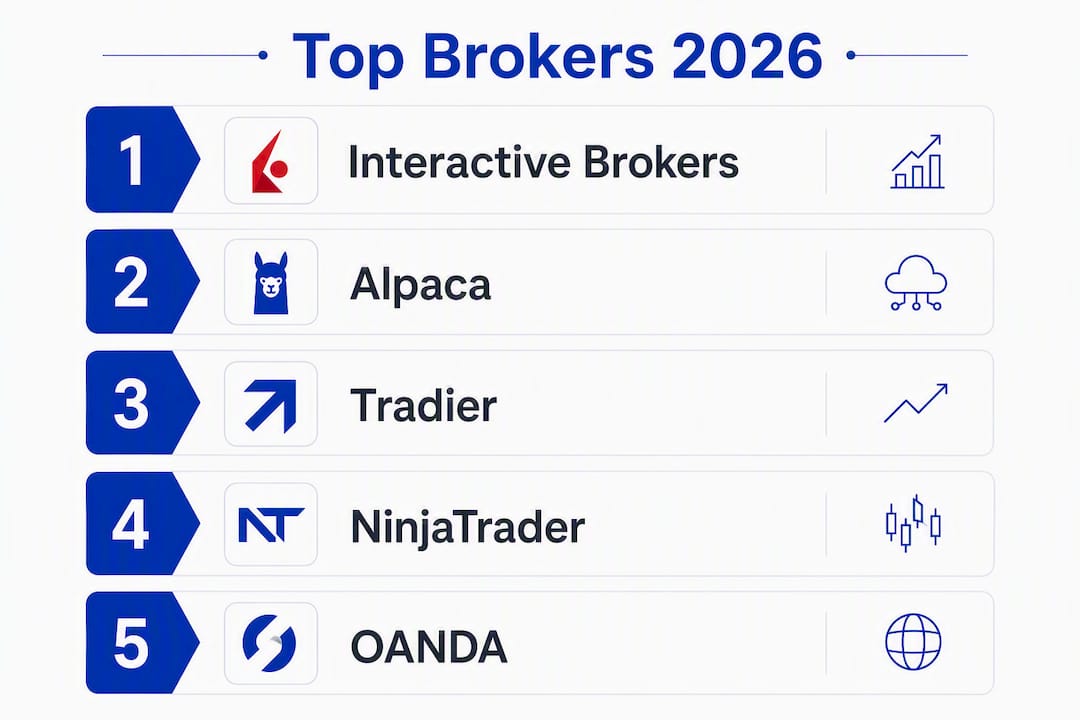
Here is the shortlist at a glance:
- Quantgenie — Best no-code path from strategy idea to live deployment; natural-language strategy translation with institutional-grade backtesting
- Alpaca — Best for solo Python developers; free paper environment mirrors the live API surface exactly
- Interactive Brokers (IBKR) — Best for multi-asset professional setups; broadest global market coverage and 150+ order types
- Tradier — Best for options-first retail strategies; order preview endpoint validates before submission
- TradeStation — Best for traders who want tight platform integration alongside API automation
- OANDA — Best for forex algorithmic traders; stable FX execution with clear REST/WebSocket endpoints
- NinjaTrader — Best for futures and high-frequency intraday strategies using desktop scripting
- QuantConnect — Best for quant developers who need a robust backtesting engine with multi-broker connectors
Table of Contents
- How do the top algorithmic trading brokers compare?
- Detailed reviews: what to actually expect from each broker
- What does algorithmic trading actually mean here?
- What makes a great broker API for algorithmic trading?
- Which broker is best for your asset class?
- Pricing and effective costs: beyond “commission-free”
- How to choose the right broker for your algorithmic setup
- How we chose and tested the brokers in this guide
- Authentication, idempotency, and the effective-cost pitfalls that break live deployments
- Key Takeaways
- When I would pick each option
- Quantgenie: build, backtest, and deploy without writing a single line of code
- Selected primary sources, API docs, and regulatory references (2026)
How do the top algorithmic trading brokers compare?
The table below covers the eight primary picks. All remaining platforms in the full list are covered in the detailed reviews section.
| Broker / Platform | Best For | API Types & Auth | Supported Markets | Order Types / Bracket-OCO | Market Data | Fees & Data Costs | Paper / Backtest | Developer Resources | Regulation / Custody |
|---|---|---|---|---|---|---|---|---|---|
| Quantgenie | No-code build → backtest → deploy | Natural-language + broker integrations | US stocks, options (via integrations) | Determined by connected broker | Institutional-grade historical data included | Subscription SaaS; no per-trade fee | Full backtesting built-in | Visual editor, AI Q&A on results | Operates via regulated broker integrations |
| Alpaca | Solo Python devs, retail automation | REST, WebSocket, SSE; API key | US stocks, options (paid tier), crypto | Bracket, OCO, trailing stop | Free real-time (IEX); paid SIP | $0 commissions (stocks); options via paid tier | Free paper env mirrors live | Python SDK, MCP V2, JS SDK | FINRA/SIPC member |
| Interactive Brokers | Multi-asset professional setups | REST, WebSocket, FIX, TWS API; API key + gateway | Stocks, options, futures, forex, bonds, crypto | 150+ order types, bracket, OCO | Real-time, historical, tick-level (fees apply) | Tiered: $0.005/share | Paper account available | IBKR API docs, client portal SDK | SEC/FINRA/SIPC; global custodian |
| Tradier | Options-first retail strategies | REST, streaming; API key + OAuth | US stocks, options | Multi-leg, bracket, preview endpoint | Real-time quotes; historical via partner | $0 stock trades; $0.35/contract options | Sandbox environment | REST docs, order preview workflow | FINRA/SIPC member |
| TradeStation | Platform-integrated automation | REST, WebSocket; API key | US stocks, options, futures, crypto | Bracket, OCO, conditional | Real-time and historical (subscription) | $0 stocks; $1.50/contract futures | Simulated trading | EasyLanguage, REST API docs | FINRA/SIPC member |
| OANDA | Forex algorithmic strategies | REST, WebSocket; API key | Forex, CFDs | Market, limit, stop, trailing | Free real-time FX; historical via API | Spread-based; no per-trade commission | Practice account (full parity) | REST/WebSocket docs, Python/Java wrappers | NFA/CFTC registered |
| NinjaTrader | Futures and intraday scripting | NinjaScript (C#-based), REST; API key | Futures, forex, stocks | Bracket, OCO, ATM strategies | Real-time and historical (data feeds) | $0 commissions (futures lease model) | Simulated trading | NinjaScript docs, community forum | NFA registered |
| QuantConnect | Quant devs, multi-broker backtesting | LEAN engine; REST; API key | Stocks, options, futures, forex, crypto | Broker-dependent | Tick-level historical (Quantbook) | Free cloud tier; paid research tiers | Full cloud backtesting | LEAN docs, community algorithms | Connects to regulated brokers |
Caveats worth noting: Paper environments are often best-case scenarios. Validate latency and rate-limit behavior in a staged live test before scaling order frequency or position size. PFOF-based zero-commission brokers can cost more at scale than tiered-commission alternatives. Regional availability varies; US traders should confirm account eligibility before opening.
Detailed reviews: what to actually expect from each broker
Quantgenie
Quantgenie sits in a different lane from the pure execution brokers below. Rather than giving you an API to code against, it lets you describe a strategy in plain English and translates that into a deterministic algorithm, backtests it against institutional-grade historical data, and connects to live brokers for deployment. The deterministic build model means the same strategy description produces the same backtest result every time, which matters enormously when you are trying to validate an edge rather than debug a code path.
The platform suits non-programmers, analysts who think in strategy logic rather than Python, and professional traders who want to prototype quickly before committing to a full engineering build. It is not the right tool if you need sub-millisecond execution or FIX connectivity; for those cases, IBKR or a dedicated co-location setup is the answer. For everyone else, the friction reduction from idea to live deployment is the real value proposition.
Alpaca
Alpaca’s paper trading environment is a genuine mirror of the live API surface, not a stripped-down simulation. That parity is rare and practically useful: the same code that runs in paper runs in production without modification. The Python SDK is mature, the MCP V2 server is officially supported, and idempotency is handled at the SDK level, which matters when you are building AI agents that may retry on failure.

Options trading requires a paid tier upgrade. Rate limits are documented and predictable. For a solo developer building a first automated equity strategy, Alpaca is the most sensible starting point in the US market.
Interactive Brokers (IBKR)
IBKR has the broadest API surface of any US broker: 150+ order types, global market access, FIX connectivity, and co-location options. The catch is operational: you must run a local TWS or IB Gateway process continuously, which adds infrastructure overhead and a security surface to manage. That gateway requirement is a real setup cost that many tutorials understate.
For a professional running multi-asset strategies across US equities, options, futures, and international markets, IBKR is hard to beat on capability. For a retail trader running a single equity momentum strategy, the operational overhead is probably not worth it compared with Alpaca or Tradier.
Pro Tip: Before going live with IBKR, run your gateway in paper mode for at least two weeks and deliberately simulate connection drops. The reconnection behavior of your automation is the most common failure point in production.
Tradier
Tradier’s standout feature is the order preview endpoint: passing preview=true validates an order’s parameters before submission, which is a clean safety net for algorithmic integrations where a malformed multi-leg options order could create unintended exposure. The REST API is lightweight, the streaming endpoint handles real-time quotes, and the $0.35/contract options pricing is competitive for retail volume.
The platform is narrower in scope than IBKR. Futures are not supported, and the historical data offering is thinner than dedicated data vendors. Use Tradier for options automation and pair it with a separate data provider for backtesting.
TradeStation
TradeStation’s EasyLanguage scripting environment has been around long enough that there is a substantial community library of pre-built strategies and indicators. The REST API adds a modern automation layer on top of that desktop heritage. Simulated trading is available across all supported asset classes.
Futures commissions at $1.50/contract are competitive. The platform is a reasonable choice for traders who want to start with visual strategy building and graduate to API automation without switching brokers.
TD Ameritrade / Charles Schwab (thinkorswim)
The thinkorswim platform carries a rich options order API and conditional order support that options-heavy automated strategies depend on. Following the TD Ameritrade acquisition by Charles Schwab, the API ecosystem is in transition; traders should verify current API availability and documentation status directly with Schwab before building a new integration. The desktop tooling remains strong for discretionary charting alongside automated execution.
OANDA
OANDA’s practice account is a full-parity environment for FX strategies, and the REST/WebSocket API documentation is among the clearest in the FX broker space. The spread-based pricing model means there is no per-trade commission, but effective costs depend heavily on the spread at execution time. For systematic FX strategies, OANDA is the most developer-accessible US-registered option.

OANDA is registered with the NFA and CFTC, which matters for US retail forex traders who need a regulated counterparty.
NinjaTrader
NinjaTrader’s NinjaScript environment (C#-based) gives futures traders a desktop-native scripting layer with ATM (Advanced Trade Management) strategies that handle bracket and OCO logic natively. The platform’s futures data feed integration is tight, and the simulated trading environment is realistic for intraday testing.
The lease model for commissions means you can access $0 futures commissions by paying an upfront platform fee, which makes the economics favorable for high-frequency futures strategies. The desktop-first architecture is a constraint if you want cloud-native deployment.
Webull
Webull’s API support is growing but remains more limited than Alpaca’s for serious automation. The app ecosystem is accessible, and the platform suits retail traders who want to automate basic equity strategies without a heavy engineering setup. Not the right choice for options automation or futures.
E*TRADE
E*TRADE offers API access for automated order routing through a mature brokerage infrastructure. The platform is a reasonable choice for retail automation that values an established brand and SIPC protections. API documentation is publicly available, though the developer community is smaller than Alpaca’s or IBKR’s.
moomoo
moomoo is expanding its API surface for retail traders. The platform’s cost structure is competitive, and it suits traders seeking low-cost access with growing automation features. API capabilities are less mature than the primary picks; verify current documentation before committing to an integration.
tastytrade
tastytrade’s $1/contract options pricing is transparent and avoids the PFOF model that inflates effective costs for high-volume options strategies. The API is improving, and the platform’s options-focused tooling makes it a credible choice for traders who run high-volume options automation and want pricing clarity.
eToro
eToro’s API offerings center on copy-trading and retail automation hooks rather than low-latency execution. The social trading features are genuinely differentiated, but the platform is not suited to systematic strategies that require precise order routing or FIX connectivity.
IC Markets
IC Markets is a forex and CFD broker known for low spreads and support for MetaTrader 4, MetaTrader 5, and cTrader. For US-based traders, availability should be confirmed directly; IC Markets primarily serves non-US markets. Spread-sensitive FX strategies benefit from the tight pricing.
FXCM
FXCM offers a stable FX API with third-party integrations and is a reasonable choice for retail and professional FX algorithmic traders. The API documentation is mature, and the platform supports multiple programming languages. US availability is limited; verify current regulatory status before opening an account.
Pepperstone
Pepperstone is execution-focused with competitive spreads and support for MetaTrader and cTrader. Latency-sensitive FX strategies benefit from the infrastructure. Like IC Markets, US availability should be confirmed directly.
FP Markets
FP Markets offers multi-platform support and broad CFD/FX instrument coverage. Suitable for retail traders needing global access; US availability requires direct verification.
Tickmill
Tickmill’s competitive FX pricing suits cost-sensitive algorithmic strategies. The API access is available, and the platform is a reasonable choice for frequent FX traders focused on minimizing per-trade costs.
FxPro
FxPro covers forex and CFD strategies with execution-focused platform offerings and API integrations. A workable option for algorithmic forex strategies where execution reliability is the primary concern.
AlgoCloud
AlgoCloud targets stock-picking algorithm developers with tools focused on model-driven strategy development and rapid prototyping. It is a useful environment for researchers building systematic equity models rather than a full execution broker.
QuantConnect
QuantConnect’s LEAN engine is the most capable open-source backtesting framework available, with tick-level historical data and connectors to multiple live brokers. The cloud platform handles the infrastructure; the free tier is genuinely usable for research. For quant developers who want to own the full research-to-execution pipeline, QuantConnect is the strongest technical option.
Build Alpha, AmiBroker, and RealTest
These three are desktop-based research and backtesting tools rather than execution brokers. Build Alpha automates signal discovery for systematic equity and ETF models. AmiBroker is a powerful, extensible desktop backtesting suite popular with DIY quants who want custom scripting. RealTest specializes in walk-forward and robustness testing, which is the right tool when you need to validate that a strategy holds up out-of-sample before risking capital.
None of these execute live trades directly; they pair with execution brokers via data feeds or export.
TradingView
TradingView’s Pine Script environment and broker integrations make it the fastest path from a chart-based idea to a live alert or automated order. The community strategy library is enormous. For traders who think visually and want to validate ideas quickly, TradingView is a practical first step before moving to a more programmatic setup.
Mindful Trader and Stock Market Guides
Mindful Trader focuses on discipline-oriented automation and educational resources for systematic trading. Stock Market Guides provides beginner-friendly content and comparisons for traders researching broker options and basic algorithmic strategies. Both are educational resources rather than execution platforms.
What does algorithmic trading actually mean here?
Algorithmic trading, as used throughout this guide, means any strategy where a computer generates and submits orders based on predefined rules, without requiring manual intervention at execution time. That covers a wide range of approaches:
- Swing trading bots that hold positions for days and rebalance on technical signals
- Intraday momentum strategies that open and close within a session
- Market-making algorithms that post bids and offers to capture spread
- Options leg automation that constructs multi-leg spreads based on volatility conditions
- Crypto bots running 24/7 on exchange APIs
A few terms matter when comparing brokers. Slippage is the difference between the price your algorithm targets and the price it actually fills at; it is a real cost that commissions do not capture. Latency is the round-trip time between your order submission and the exchange acknowledgment; for intraday strategies, milliseconds matter. Paper-to-live parity describes how closely a broker’s sandbox environment mirrors real execution behavior. A paper environment that does not enforce rate limits or simulate realistic fill delays will produce backtest results that fall apart in production.
WebSocket streaming often reduces latency significantly versus REST polling, which is why protocol choice is a genuine strategic decision for any strategy running at intraday frequencies.
What makes a great broker API for algorithmic trading?
Matching a broker to your automation stack matters more than finding a universally superior broker. The checklist below covers the technical levers that determine fit.
- Authentication model. API key authentication supports fully headless deployments. OAuth requires a browser-based consent flow, which breaks unattended bots. OAuth-only brokers create real headless deployment friction for AI agents and automated servers. Confirm which model a broker supports before building.
- Idempotency and retry behavior. When your bot retries a failed order submission, does the broker deduplicate it or create a second order? Brokers that support client-order-ID-based idempotency prevent accidental double-fills. Alpaca handles this at the SDK level; IBKR requires careful implementation on your side.
- Native bracket and OCO order support. Bracket orders attach take-profit and stop-loss exits to an entry in a single submission, which is the correct approach for risk-managed automation. Brokers that require you to manage exit orders separately introduce a failure mode: if the entry fills and the exit submission fails, you hold an unprotected position.
- Streaming vs. polling. REST endpoints are adequate for account queries and low-frequency order management. For live event handling, WebSocket or FIX streaming is the right choice.
- Rate limits. Documented, predictable rate limits let you design your order flow around them. Undocumented or inconsistently enforced limits cause production failures at the worst moments.
- MCP (Model Context Protocol) support. Brokers with official MCP servers (Alpaca currently leads here) integrate more cleanly with LLM-based trading agents, which is increasingly relevant for teams building AI-driven automation.
- Multi-leg options support. If your strategy involves spreads, condors, or calendars, confirm the broker’s API supports multi-leg submissions natively rather than requiring sequential single-leg orders.
- Paper/sandbox parity. The sandbox should enforce the same rate limits, order types, and streaming behavior as the live environment. A sandbox that does not is useful for syntax testing only, not for validating strategy behavior.
Pro Tip: Run three specific tests before going live: a bracket order that hits the take-profit leg, a bracket order that hits the stop-loss leg, and a deliberate duplicate submission to verify idempotency. If any of these behave differently in paper versus live, you have found a parity gap that will cost you money.
Which broker is best for your asset class?
US equities and ETFs
Alpaca and Interactive Brokers are the two strongest choices. Alpaca wins on developer experience and zero-commission pricing for retail volume. IBKR wins on order-type depth and access to international listings. For a simple equity momentum strategy, Alpaca is the faster path to production. For a strategy that needs to route to specific exchanges or access international ADRs, IBKR is the right infrastructure.
Options
Tradier, tastytrade, and TD Ameritrade/Schwab (thinkorswim) are the strongest options-focused API brokers for US traders. Tradier’s order preview endpoint is a practical safety net for multi-leg submissions. tastytrade’s $1/contract pricing is the most transparent in the category. The thinkorswim API has the richest conditional-order support but is in transition post-Schwab acquisition.
Futures
NinjaTrader is the natural home for futures automation in the US, with native ATM strategy support and a strong data feed ecosystem. IBKR is the alternative for traders who want futures alongside equities and options in a single account.
Forex
OANDA is the most developer-accessible NFA/CFTC-registered FX broker for US traders. IC Markets, Pepperstone, and FP Markets offer lower spreads and broader platform support but have limited or no US availability; confirm eligibility before opening an account.
Crypto
Alpaca supports crypto on its platform. QuantConnect connects to crypto exchanges via the LEAN engine. For pure crypto automation, dedicated exchange APIs (Coinbase Advanced, Kraken) often provide better depth and lower latency than broker-routed crypto.
Multi-asset strategies
Separating execution and market-data roles is the right architecture for multi-asset strategies. Use a broker API for order routing and a dedicated data vendor (Polygon.io, Databento, or similar) for historical and tick-level data. This avoids the instability that comes from relying on a broker’s data feed for backtesting while also using it for live execution.
Pricing and effective costs: beyond “commission-free”
Zero-commission pricing is a marketing frame, not a cost analysis. The real cost of a trade has several components:
- Commission: The explicit per-share or per-contract fee
- Payment for order flow (PFOF): The broker routes your order to a market maker who pays for the privilege; the market maker profits from the spread, and you receive a slightly worse fill price
- Effective spread / market impact: The difference between the midpoint price and your fill price
- Exchange and regulatory fees: SEC Section 31 fees, FINRA TAF, exchange access fees
- Market data subscriptions: Real-time SIP data, Level 2, options chains
- Co-location and FIX access fees: For professional setups requiring direct market access
Zero-commission brokers can be more expensive at scale due to PFOF and effective spread; tiered-commission brokers often become cheaper above higher notional volumes. Here is a simplified illustration:
| Cost Component | Zero-Commission Broker (PFOF) | Tiered-Commission Broker (IBKR Pro) |
|---|---|---|
| Commission per share | $0 | — |
| Estimated PFOF spread cost | $1.50 per contract | Minimal (direct routing) |
| Real-time data (SIP) | Often included | $1.50 per contract |
| Net cost at low volume | Lower | Higher |
| Net cost at high volume | Higher (spread compounds) | Lower (tiered rates fall) |
The crossover point depends on your average trade size and frequency. A strategy trading 50,000 shares per day at tight spreads will almost certainly pay less in total costs with IBKR Pro tiered pricing than with a PFOF-based zero-commission broker.
Practical checklist for cost modeling:
- Calculate your expected monthly share/contract volume before choosing a fee structure
- Request a sample execution quality report from any PFOF broker you are evaluating
- Factor in data subscription costs; free real-time data (IEX via Alpaca) has lower depth than paid SIP feeds
- For options, compare the all-in cost: commission + exchange fee + regulatory fee per contract
- If you need co-location or FIX access, budget for those separately; they are not included in standard retail accounts
How to choose the right broker for your algorithmic setup
The decision comes down to four variables: your strategy profile, your technical stack, your capital scale, and your regulatory requirements.
Step 1: Define your strategy profile. What asset class? What frequency? What order complexity? A daily rebalancing equity strategy has completely different broker requirements than an intraday options spread strategy.
Step 2: Map required API features. From the checklist in the section above, identify which features are non-negotiable for your strategy. Bracket orders? Multi-leg options? FIX connectivity? Headless API-key auth?
Step 3: Run a paper test. Open a sandbox account and run your actual strategy logic, not a simplified version. Test bracket orders, test retries, test rate limits. Validate that the paper environment behaves the way the documentation says it does.
Step 4: Model your costs. Use the framework above. At your expected volume, which fee structure produces the lower total cost?
Step 5: Apply go/no-go criteria. Before committing capital, confirm: Is the broker regulated by the SEC, FINRA, NFA, or CFTC as appropriate for your asset class? Is SIPC or equivalent custody protection in place? Is there a public SDK with a changelog and an active developer community?
Questions to ask broker support before building:
- Does your API support client-order-ID-based idempotency?
- What are the documented rate limits for order submission and market data?
- Does your paper environment enforce the same rate limits as the live environment?
- What is your SLA for API uptime, and where is the status page?
- Do you support headless API-key authentication, or is OAuth required?
Red flags:
- No sandbox or paper environment
- OAuth-only authentication with no headless alternative
- Undocumented error codes in the API reference
- No public changelog for API updates
- Developer community forum that has not been updated in over a year
Trust signals:
- Public SDK on GitHub with recent commits
- Documented rate limits and error codes
- Active developer community (Discord, forum, Stack Overflow tag)
- Transparent execution quality reporting
- Clear regulatory registration and custody disclosures
For readers evaluating verifiable AI trading performance, the same trust-signal framework applies: look for audited backtest results, disclosed data sources, and out-of-sample validation rather than equity curves that start at the strategy’s best entry point.
How we chose and tested the brokers in this guide
The selection process for this guide prioritized API capability over brand recognition. Every broker and platform was evaluated against a consistent set of criteria:
- Regulation and custody: — SEC, FINRA, NFA, or CFTC registration; SIPC membership or equivalent
Testing methodology included sandbox parity checks (submitting bracket orders, OCO orders, and multi-leg options orders in paper mode and comparing behavior against documentation), sample order flow reviews, documentation audits for completeness and recency, and latency spot checks where public data was available.
Important disclaimers: API specifications, fee structures, and account requirements change. All figures in this guide reflect publicly available information as of 2026; verify current specs directly with each broker before opening an account. Regional availability varies; some brokers listed here have limited or no availability for US retail accounts. Account tier affects API access at several brokers (notably IBKR and Tradier); confirm your tier’s entitlements before building.
Authentication, idempotency, and the effective-cost pitfalls that break live deployments
These three issues account for the majority of production failures in algorithmic trading systems. Understanding them before you build saves significant debugging time.
Authentication in practice
Authentication model is often the primary bottleneck for algorithmic agents. The practical difference:
- API key authentication: Your bot stores a key and secret, includes them in every request header, and runs indefinitely without human interaction. This is the correct model for headless servers and AI agents.
- OAuth 2.0: Requires a browser-based authorization flow to obtain an access token. Tokens expire and must be refreshed, often requiring user interaction. This works for applications where a human is present at setup; it breaks for fully automated deployments.
- Gateway-based (IBKR TWS/IB Gateway): Your automation connects to a local process that handles the broker session. The gateway must stay running, authenticated, and connected. This adds infrastructure overhead but gives you access to IBKR’s full API surface.
For a headless deployment on a cloud server, API key authentication is the only model that works without engineering workarounds. If a broker you are evaluating requires OAuth with no API-key alternative, that is a meaningful constraint for unattended automation.
Idempotency and retry behavior
Network failures happen. When your bot retries a failed order submission, the broker either recognizes the duplicate (idempotent) or creates a second order (non-idempotent). The difference between these two outcomes is the difference between a graceful retry and an accidental double position.
Alpaca handles idempotency via a client_order_id field: submit the same ID twice and the second submission returns the existing order rather than creating a new one. IBKR requires you to track order state on your side and implement deduplication logic manually. Before deploying any strategy that retries on failure, test this behavior explicitly in the sandbox.
Deployment pro tips
Pro Tip: Run your automation server in the same AWS or GCP region as the broker’s primary infrastructure. For US brokers, that is typically us-east-1 (AWS) or us-east1 (GCP). The latency reduction from co-location is meaningful for intraday strategies even without formal co-location arrangements.
A staged deployment is the only responsible path to live trading:
- Start in the sandbox and validate all order types, retry behavior, and rate-limit handling
- Move to a small live pilot with hard position limits and a kill-switch that can halt all orders
- Monitor fill quality, slippage, and actual latency against your paper-environment benchmarks
- Scale only after confirming that idempotency, retry semantics, and real-world latency match your model
For automated AI trading portfolios, the same staged approach applies: validate the signal generation logic in paper mode before connecting it to a live execution layer.
Key Takeaways
The best broker for algorithmic trading is the one whose API model, order types, and cost structure match your specific strategy, not the one with the most name recognition.
| Point | Details |
|---|---|
| API auth model determines deployment | API-key brokers support headless automation; OAuth-only brokers require workarounds for unattended bots. |
| Paper parity is not guaranteed | Always test bracket orders, retries, and rate limits in the sandbox before committing capital. |
| Zero-commission is not zero-cost | PFOF and effective spread compound at scale; tiered-commission brokers often cost less at high volume. |
| Separate execution from data | Use a dedicated data vendor for historical and tick-level backtesting; do not rely solely on your broker’s feed. |
| Quantgenie removes the coding barrier | Quantgenie covers build, backtest, and deploy with broker integrations and no code required, suited for non-programmers and rapid prototypers. |
When I would pick each option
The honest answer is that the right broker changes based on three variables: how much you want to code, what you are trading, and how much capital you are deploying.
If you are not a programmer or you want to move from idea to live strategy in days rather than weeks, Quantgenie is the most direct path. The natural-language strategy translation removes the entire API integration layer from your problem. You still connect to a regulated broker for execution, but the build-and-test workflow happens in a no-code environment with institutional-grade data. That is a genuinely different value proposition from every other option on this list.
If you are a Python developer building your first automated equity strategy, Alpaca is the right starting point. The free paper environment, the MCP V2 server, and the SDK quality mean you spend time on strategy logic rather than plumbing. The zero-commission structure works fine at retail volume.
For a professional running multi-asset strategies across equities, options, futures, and international markets, IBKR is the only broker with the coverage and order-type depth to handle it all in one account. The gateway overhead is real, but at professional scale, the operational cost is worth the capability.
Options-heavy strategies deserve a closer look at Tradier and tastytrade. Tradier’s order preview endpoint is a genuine safety feature for multi-leg submissions. tastytrade’s $1/contract pricing is the most transparent options cost structure available for US retail accounts.
For forex, OANDA is the most accessible NFA/CFTC-registered option for US traders. For futures, NinjaTrader’s ATM strategy system and futures data integration are hard to match on the desktop.
The one thing I would push back on in most broker comparison articles: the emphasis on commissions over everything else. At the volumes most retail algorithmic traders operate, the difference between $0 and $0.005/share in commissions is smaller than the difference between a broker with documented idempotency and one without. Build your selection criteria around API reliability first, cost structure second.
Quantgenie: build, backtest, and deploy without writing a single line of code
Every broker on this list requires you to write code, manage API credentials, handle retries, and debug order flow. That is the right approach for developers. For everyone else, it is a significant barrier between a strategy idea and a live position.
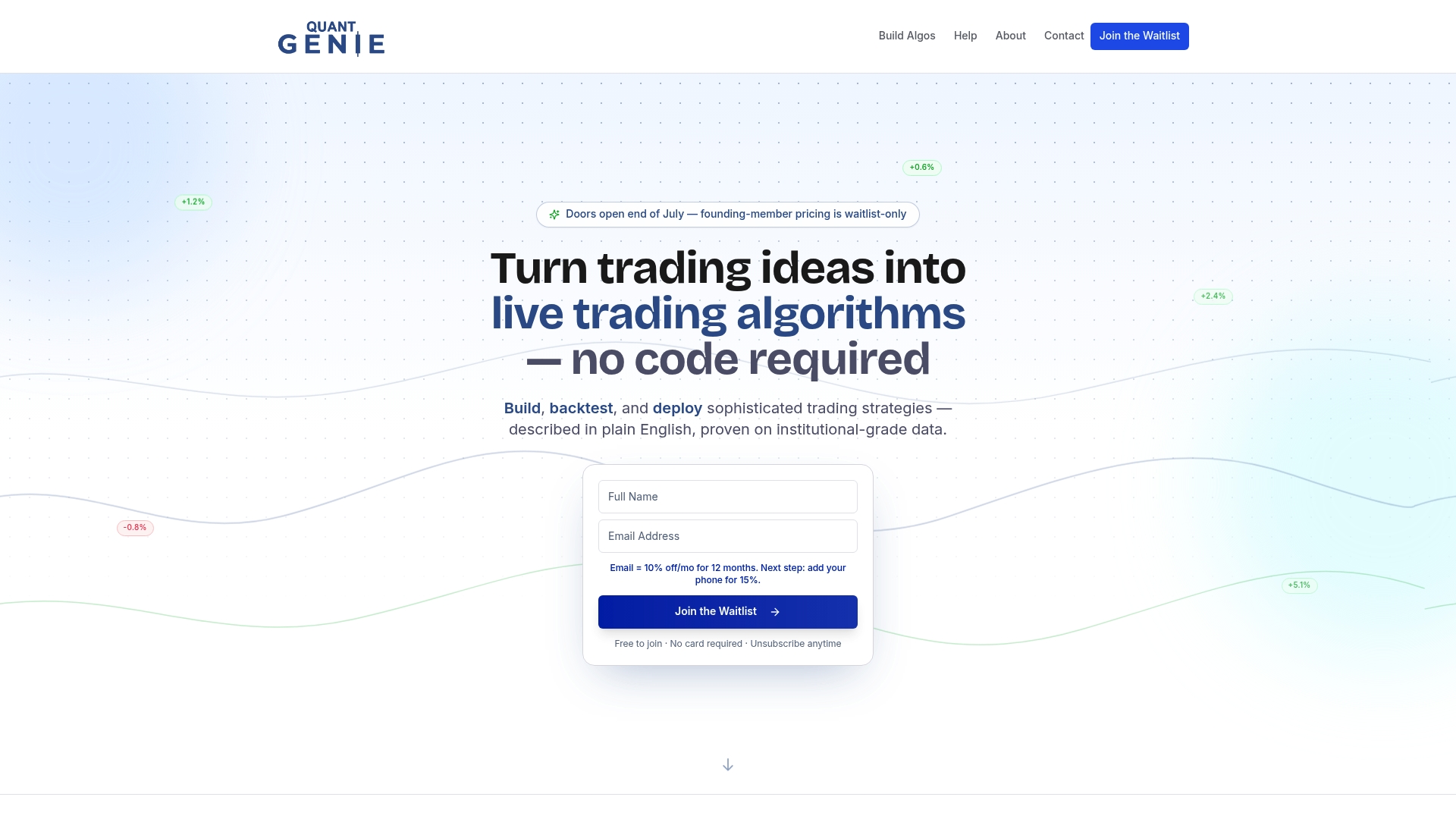
Quantgenie takes a different approach. Describe your strategy in plain English, and the platform translates it into a deterministic algorithm, backtests it against institutional-grade historical data, and connects to live brokers for deployment. The deterministic build model means the same description produces the same result every time, which is the foundation of any credible backtest. Performance metrics, portfolio risk analysis, and AI-assisted Q&A on your backtest results are all built into the platform.
The fit is clearest for non-programmers, analysts who prototype strategies faster than they can code them, and professional traders who want to test an idea before committing engineering resources to it. If you need sub-millisecond FIX execution or a custom C++ order router, a direct broker API is the right tool. For the majority of retail and professional traders who want a reliable path from strategy concept to live deployment, start building on Quantgenie or get early access via SMS.
Selected primary sources, API docs, and regulatory references (2026)
Specifications were reviewed against publicly available documentation as of 2026. Verify current details directly with each provider before building.
- Alpaca vs IBKR vs Tradier: Broker APIs for AI Agents 2026 — Research article; covers auth models, MCP V2, idempotency, and effective-cost analysis
- Broker API Comparison Guide for Trading Automation — Developer guide; framework for matching broker API to automation stack and separating execution from data
- Broker API Comparator | AI Fin Hub — Developer guide; OAuth vs API key analysis and staged deployment guidance
- Best Broker APIs for Algorithmic Trading in 2026 | TradeAlgo — Research article; WebSocket latency benchmarks and bracket order broker coverage
- Trading — Tradier API docs — API documentation; order preview endpoint workflow for algorithmic integrations
- Interactive Brokers API — Official API documentation; gateway setup, order types, and market coverage
- NFA Basic Profile — Regulatory reference; NFA registration verification for futures brokers
This article is general information for educational purposes, not financial or investment advice. Confirm current broker specifications, regulatory status, and account requirements with each provider or a qualified financial professional before making trading or account decisions.