
Best Horizon Alternatives for No-Code Algo Traders

Quantgenie is the strongest no-code alternative to Horizon for traders who need deterministic backtesting, plain-English strategy authoring, and direct broker deployment without writing a single line of code.
- Quantgenie translates natural-language strategy descriptions into deterministic algorithms, so the same inputs always produce the same backtest output.
- Institutional-grade market data powers every backtest, eliminating the data-quality gaps that distort results on lighter platforms.
- Direct broker integrations let you move from a validated backtest to a live or paper account without rebuilding your setup.
- A sandbox trial is available, so you can verify reproducibility before committing.
The comparison table below shows how Quantgenie stacks up against Horizon across the dimensions traders actually care about.
Table of Contents
- How do Quantgenie and Horizon compare side by side?
- Why are traders looking for alternatives to Horizon right now?
- How do you evaluate no-code trading platforms before committing?
- What must a modern no-code trading platform actually deliver?
- How do you trial an alternative safely before full migration?
- Which traders should use Quantgenie and when does Horizon still make sense?
- Key Takeaways
- Why the category confusion around Horizon matters more than you think
- Quantgenie gives you a faster path from strategy idea to live deployment
- Useful sources for deeper reading
How do Quantgenie and Horizon compare side by side?
| Dimension | Quantgenie | Horizon |
|---|---|---|
| Best for / primary use case | Retail quants, analysts, prop traders needing fast no-code iteration | Enterprise desktop virtualization and managed remote-work environments |
| No-code / NLP features | Plain-English strategy authoring via NLP; drag-and-drop visual editor | Not applicable — desktop delivery platform, not an algo-trading tool |
| Backtest rigor and determinism | Deterministic algorithm guarantee; fixed-seed, reproducible results | No native backtesting capability |
| Market-data quality | Institutional-grade historical feeds; documented tick handling | No market-data provision |
| Broker integrations / live deploy | Direct broker API integrations; paper and live account deployment | Not applicable |
| Strategy visualization and metrics | Portfolio risk analysis, performance metrics dashboard, AI-assisted Q&A | Not applicable |
| Pricing and trial | Tiered subscription; sandbox trial available | Enterprise licensing; no trading-specific trial |
| Security / data isolation | Validated algorithm isolation; deterministic build controls | Remote desktop security protocols |
| Support and onboarding | Guided onboarding for strategy authoring and backtesting | IT-focused support for desktop infrastructure |

The table makes one thing clear: Horizon is a remote desktop virtualization platform, not a trading algorithm tool. Traders searching for Horizon alternatives in the algo-trading context are almost always looking for something Horizon was never designed to provide. Quantgenie fills that gap directly. Individual quants get reproducible backtests they can interrogate with plain English. Prop traders get broker connectivity without custom API work. Analysts get a visual metrics layer that surfaces risk before deployment.
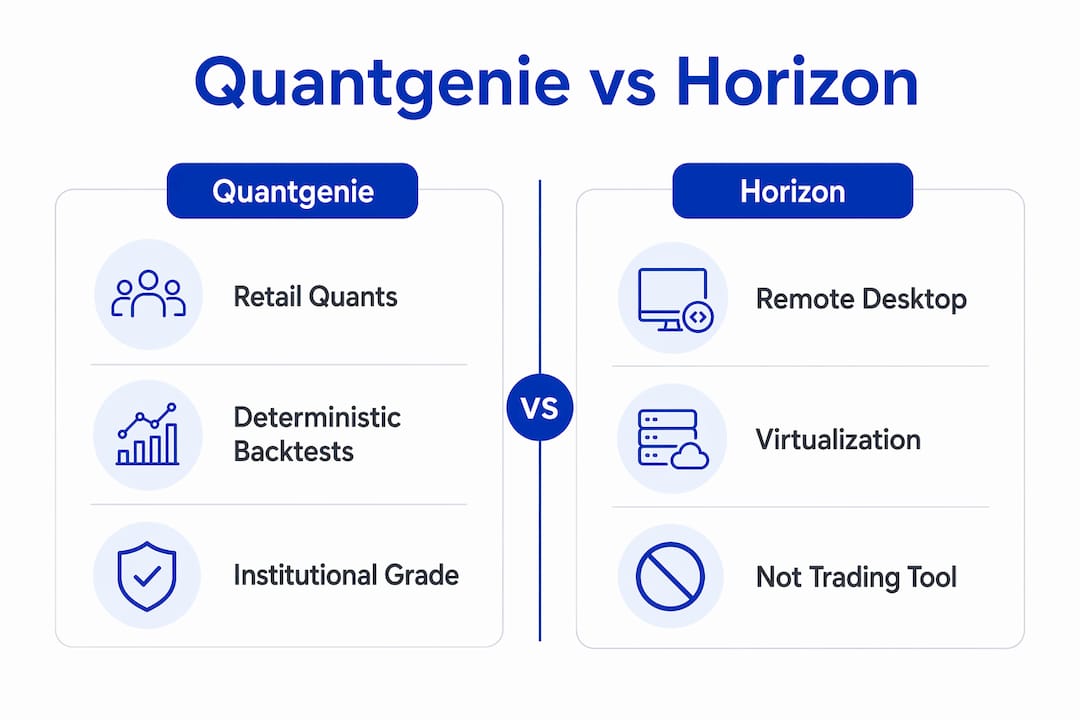
Trust signals worth noting: Quantgenie publishes its backtesting methodology, guarantees deterministic algorithm builds, and offers a sandbox environment for pre-commitment validation.
Why are traders looking for alternatives to Horizon right now?
The shift is strategic, not incremental. Traders and analysts are moving toward cloud-native platforms with transparent pricing and faster iteration cycles, not just hunting for feature parity with whatever they used before.
Common pain points driving the search:
- Opaque backtest assumptions. Legacy and general-purpose platforms rarely document how they handle tick data, slippage, or order execution. You get a return figure with no audit trail.
- Difficult broker integration. Connecting a backtest environment to a live broker account often requires custom middleware or manual export/import steps.
- Heavyweight setup. Full virtual desktop infrastructure carries significant backend overhead that slows iteration for traders who just want to test a new signal.
- Slow iteration cycle. Writing, testing, and revising a strategy in a code-first environment takes days. No-code NLP platforms compress that to hours.
- Pricing opacity. Per-user or autoscaling pricing can escalate sharply if usage patterns are not modeled carefully before signing a contract.
Pro Tip: When reviewing any vendor’s backtest documentation, ask specifically how they handle data versioning and order execution sequencing. A vendor that cannot answer both questions in writing almost certainly does not offer deterministic results.
How do you evaluate no-code trading platforms before committing?
Start with three non-negotiables: deterministic backtesting, documented data provenance, and confirmed broker integration for your specific accounts. Everything else is secondary.
Evaluation checklist:
- Backtest determinism. Can the vendor demonstrate that running the same strategy twice produces bit-for-bit identical results? Ask for a written guarantee and a methodology document.
- Market-data provenance and lag. What data source feeds the backtest? What is the minimum tick resolution? Is survivorship bias addressed?
- Supported broker list. Which brokers connect natively? What is the deployment path from backtest to paper account to live account?
- Strategy visualization and risk metrics. Can you inspect drawdown, Sharpe ratio, and position-level risk before going live?
- Pricing model and billing traps. Is pricing per strategy, per user, or per compute hour? Cost advantages depend on modeling your actual usage before you sign.
- Sandbox or demo availability. A platform that will not let you run a real backtest before purchase is hiding something.
Vendor questions to ask during a trial:
- “Show me two runs of the same strategy with identical inputs. Are the outputs byte-identical?”
- “What happens to my backtest results if you update your historical data feed?”
- “Which brokers support paper-account deployment from your platform today?”
Red flags: vague answers about “similar” results instead of identical ones, inability to name the data vendor, and pricing that requires a sales call to understand.
What must a modern no-code trading platform actually deliver?
The must-have list is shorter than most vendors imply. Five capabilities separate a real no-code trading platform from a dressed-up spreadsheet tool:
- NLP strategy authoring. You describe the strategy in plain English; the platform generates the algorithm. No Python, no pseudocode.
- Deterministic backtesting. Fixed-seed simulations, documented tick handling, and a reproducible order execution model. Same inputs, same outputs, every time.
- Institutional-grade market feeds. Validated historical data with documented survivorship-bias handling and minimum tick resolution.
- Broker API deployment. Direct connection to live and paper accounts without manual export steps.
- Reproducible results with an audit trail. Data versioning so a backtest run today matches one run six months from now.
Here is what that looks like in practice. A trader describes a mean-reversion strategy: “Buy when the 10-day RSI drops below 30 and the price is above the 200-day moving average; sell when RSI crosses 50.” Quantgenie translates that into a deterministic algorithm, runs it against institutional-grade historical data, and returns a performance report with drawdown curves, Sharpe ratio, and trade-level logs. Running it again tomorrow produces the same numbers. That reproducibility is what lets you trust the result enough to deploy.
Modern platforms can also maintain data isolation without sacrificing simplicity, using validated algorithm controls rather than complex infrastructure overhead.
How do you trial an alternative safely before full migration?
Run a staged trial: sandbox first, then paper trading, then a limited live rollout with defined success metrics at each gate.
- Align your data. Confirm the alternative platform uses the same date range and data source as your current backtest baseline.
- Reproduce one existing strategy. Pick your best-documented current strategy and rebuild it in the new platform. Compare outputs line by line.
- Run parallel paper trading. For two to four weeks, run the new platform’s signals alongside your existing setup without committing capital.
- Reconcile results. Compare fill prices, signal timing, and drawdown figures between the two environments. Unexplained divergence is a red flag.
- Validate broker integration. Confirm order routing, rate limits, and kill-switch behavior before any live capital touches the new system.
- Set a go/no-go metric. Define your success threshold before the trial starts, not after you see the results.
Successful migrations rarely work as like-for-like replacements. Expect to re-examine your strategy assumptions during the process. Build in contingency time, and keep your existing setup live until the new platform clears every gate.
Circuit breakers and kill switches are not optional. Confirm the platform supports position-level and account-level kill switches before paper trading begins.
Which traders should use Quantgenie and when does Horizon still make sense?
Quantgenie fits traders who need fast iteration and reproducible results:
- Retail quants testing multiple signal variations per week.
- Analysts who need to present backtest evidence to a committee without writing code.
- Prop traders who want broker-connected paper trading before committing capital.
- Anyone whose current platform cannot answer “are your backtests deterministic?” with a yes and a methodology document.
Horizon remains appropriate for:
- Enterprise IT teams managing remote desktop environments for large workforces.
- Organizations with deeply embedded VMware or Omnissa infrastructure that would require significant re-architecture to replace.
The decision is straightforward. If you are searching for a trading algorithm platform and landed on Horizon, you are looking at the wrong category of software. Start Quantgenie’s sandbox trial, run your most familiar strategy through the NLP authoring flow, and check whether the backtest output matches your expectations. That single test tells you more than any feature comparison.
Key Takeaways
Quantgenie is the recommended no-code alternative for traders who need deterministic backtesting, institutional-grade data, and direct broker deployment without writing code.
| Point | Details |
|---|---|
| Horizon is a different category | Horizon is a desktop virtualization platform, not a trading algorithm tool — the comparison is a category mismatch. |
| Determinism is the first filter | Require a written deterministic backtesting guarantee and a methodology document before shortlisting any platform. |
| Staged trial reduces risk | Run sandbox, then paper trading, then limited live rollout with defined success metrics at each gate. |
| Pricing needs usage modeling | Per-user or autoscaling pricing can escalate; model your actual usage before signing any contract. |
| Quantgenie covers the full workflow | Quantgenie handles NLP strategy authoring, deterministic backtesting, and broker deployment in one platform with a sandbox trial available. |
Why the category confusion around Horizon matters more than you think
Most traders who search for Horizon alternatives are not actually comparing trading platforms. They are caught in a naming collision between a desktop virtualization product and whatever algo-trading tool they heard about in a forum. That confusion is expensive. It sends traders down evaluation paths for software that was never designed to backtest a moving-average crossover, let alone deploy it to a broker account.
The deeper issue is that the no-code trading space has matured faster than most traders realize. A platform that translates plain English into a deterministic algorithm and connects directly to a broker account is no longer a niche research tool. It is a production-grade workflow. The traders who figure that out early spend less time debugging code that was never theirs to write and more time refining the signals that actually drive returns.
Quantgenie’s deterministic guarantee is the detail worth anchoring on. Reproducibility is not a marketing claim in this context. It is the difference between a backtest you can defend and one you have to apologize for.
Quantgenie gives you a faster path from strategy idea to live deployment
Traders who have spent weeks debugging a backtest environment or wrestling with broker API documentation will recognize what Quantgenie actually offers: the time between “I have a strategy idea” and “I have a validated, broker-connected backtest” shrinks from weeks to hours. You describe the strategy in plain English, the platform generates a deterministic algorithm, and institutional-grade historical data runs the test. No infrastructure to manage, no code to maintain.
The sandbox trial is the right starting point. Bring one strategy you already understand well, run it through the NLP authoring flow, and compare the backtest output against your existing results. If the numbers align and the methodology document answers your questions about tick handling and slippage, you have your answer. Visit Quantgenie to start the trial and request a demo of the broker deployment workflow.
Useful sources for deeper reading
- Horizon alternatives — Nerdio: Industry analysis on migration drivers, pricing trade-offs, and contingency planning for organizations moving off incumbent platforms.
- Top 5 VMware Horizon alternatives — Venn: Covers lightweight, application-first delivery models and security considerations for modern remote-work alternatives.
- Top Omnissa Horizon alternatives — GO-Global: Explains when single-application delivery outperforms full desktop virtualization stacks.
- QuantGenie platform: Full description of Quantgenie’s NLP strategy authoring, deterministic backtesting methodology, and broker integration capabilities.