
Order Types for Algorithms: What Builders Must Know

The order types that matter most for execution algorithms are market, limit, stop, stop-limit, IOC/FOK, iceberg/hidden, pegged, MIT, OPO/OCO, and the templated execution strategies VWAP, TWAP, and POV. The one-line selection rule: choose by objective.
- Guarantee execution: market orders, IOC, FOK
- Control price: limit, stop-limit, pegged, peg-with-limit
- Hide footprint: iceberg, hidden/reserve, dark-aggregation algos
- Pace a large order: VWAP, TWAP, POV (participation-of-volume)
- Automate exits or entries: stop, stop-limit, MIT, OPO/OCO
Knowing which order types for algorithms to reach for first is half the battle. The other half is understanding the trade-offs each one forces on you — execution certainty against price control, and visibility against liquidity capture. The sections below map every major type to its algorithmic use case, show the trade-offs explicitly, and give you a backtesting framework to validate your choices before going live. Quantgenie’s deterministic backtesting environment is referenced throughout as the recommended way to test these combinations without writing code.
Key Takeaways
Choosing the right order types for algorithms comes down to one rule: match the order type to the objective, then validate the choice under realistic market conditions before going live.
| Point | Details |
|---|---|
| Match order type to objective | Use market/IOC for urgent fills; use limit/pegged for price-sensitive pacing; use iceberg to hide footprint. |
| Stop vs. stop-limit trade-off | Stop orders guarantee execution; stop-limit orders control price but risk non-execution through a gap. |
| Execution algos use child order mixes | VWAP and TWAP emit limit and pegged child orders; POV shifts toward market/IOC as participation aggressiveness rises. |
| Backtest under stress conditions | Include gap events and high-volatility regimes to expose stop-limit non-execution and slippage edge cases. |
| Quantgenie for deterministic testing | Quantgenie’s deterministic backtesting reproduces identical results under the same conditions, making parameter sweeps reliable. |
Table of Contents
- What are the core order types algorithms use?
- Which advanced order types do execution algorithms rely on?
- How do VWAP, TWAP, and POV algorithms work?
- How do time-in-force settings affect algorithmic orders?
- How do algorithms combine order types to meet execution goals?
- What trade-offs must every execution algorithm balance?
- What runtime controls does a live execution algorithm need?
- How should you backtest order-type behavior before going live?
- The order type choices that actually matter in practice
- Build and test your order-type strategy with Quantgenie
- Sources
What are the core order types algorithms use?
Market, limit, stop, stop-limit, and trailing stop are the five primitives every execution algorithm is built on. Understanding their mechanics at the exchange level is non-negotiable before you layer any advanced logic on top.
Market orders
A market order executes immediately at the best available price. Execution is guaranteed; price is not. Algorithms emit market orders when speed outweighs price sensitivity: urgent portfolio rebalancing, stop-loss triggers, or the final sweep of a liquidity-seeking algo that has run out of time.
Price scenario 1: Stock trades at $50.00 bid / $50.05 ask. A market buy fills at $50.05 or worse if the ask depth is thin. In a fast market, the fill could be $50.20.
Price scenario 2: A gap-down open moves the stock from $50 to $44 overnight. A stop-loss set at $47 triggers a market order that fills at $44.10, not $47. That is negative slippage, and it is the cost of guaranteed execution.
Limit orders
A limit order executes only at the specified price or better. Price is controlled; execution is not. Algorithms use limit orders as the default child order type when pacing a large parent order, because they avoid chasing the market and reduce implementation shortfall.
Price scenario 1: Algo posts a limit buy at $49.90 while the market trades at $50.05. The order rests in the book, fills if the price dips, and never pays more than $49.90.
Price scenario 2: The market moves up sharply to $51.00 and never returns. The limit order expires unfilled. That is non-execution risk, and it is the cost of price control.
Stop (stop-loss) orders
A stop-loss order triggers a market order when the stop price is hit. Execution is guaranteed at the next available market price. Algorithms use stop orders for automated exit rules: drawdown limits, trailing exits, and hard-floor risk controls.
Stop-limit orders
A stop-limit order triggers a limit order when the stop price is hit. It avoids negative slippage but introduces non-execution risk: if the market gaps through the limit price, the order sits unfilled. Algorithms use stop-limits when the strategy can tolerate staying in a position rather than taking a bad fill.
Price scenario: Stop set at $47, limit at $46.50. A gap-down open prints $44. The stop triggers, but the limit order never fills because the market is already below $46.50. The position remains open.
Trailing stop
A trailing stop adjusts the stop price as the market moves in the trader’s favor, locking in gains while allowing upside. Algorithms use trailing stops on momentum exits, where the exit level should float with the price rather than stay fixed.
| Order Type | Execution Guarantee | Price Control | Common Algo Usage |
|---|---|---|---|
| Market | Yes | None | Urgent fills, stop-loss triggers, final sweeps |
| Limit | No | High | Paced child orders, passive posting |
| Stop (stop-loss) | Yes (at market) | None | Automated exits, drawdown controls |
| Stop-limit | No | High | Price-sensitive exits, gap-risk tolerance required |
| Trailing stop | Yes (at market) | None | Momentum exits, floating risk floors |
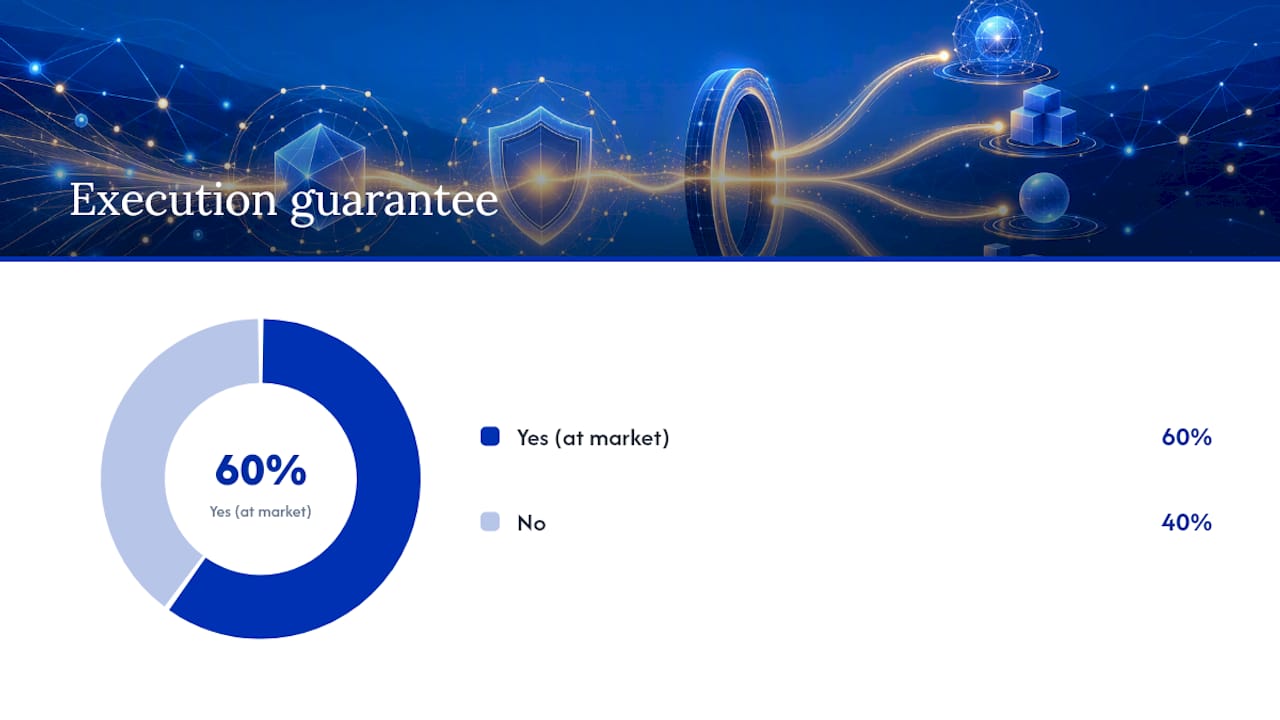
Pro Tip: In volatile instruments like small-cap stocks or leveraged ETFs, stop orders can ensure execution but not price, while stop-limit orders protect price but risk leaving you in a losing position through a gap. Default to stop (market) for hard risk limits; use stop-limit only when you can accept non-execution.
Which advanced order types do execution algorithms rely on?
Beyond the five primitives, execution algorithms depend on a set of exchange and venue-level order types that reduce footprint, control posting behavior, or trigger conditional child orders. FINRA recognizes market, limit, and stop orders as the three core categories, but broker platforms and exchanges expose many more niche types that algos use daily.
Iceberg and hidden orders
An iceberg order displays only a small portion of the total order size to the market. The rest sits as a reserve quantity, refreshing automatically as the visible portion fills. A fully hidden order shows nothing at all. Algorithms use icebergs when working a large position in a liquid name: the visible slice attracts natural contra flow without advertising the full intent.
Exchanges and broker platforms support pegged orders, midpoint pegs, and hidden/reserve quantities that algos use to float with the quote or conceal price impact. The practical implication for algo designers: not every venue supports every modifier, so your routing logic must detect exchange capabilities before submitting.
Pegged and midpoint peg orders
A pegged order floats its price relative to the best bid or offer, staying passive without requiring constant repricing. A midpoint peg rests between the best bid and offer, capturing the spread rather than paying it. Peg-with-limit adds a price floor or ceiling so the order never drifts past an acceptable level. These are the workhorses of passive execution algos that want to minimize market impact without sitting at a fixed price.
Post-only and reduce-only
Post-only orders are rejected if they would immediately execute as a taker; they only add liquidity to the book. Algorithms use post-only to earn maker rebates and avoid crossing the spread. Reduce-only orders (common in futures and crypto venues) can only decrease an existing position, preventing accidental position flips from child order logic errors.
OPO, OCO, and MIT
- Order-Places-Order (OPO): a parent order that, once filled, automatically places a child order. Useful for bracket strategies where an entry triggers a simultaneous stop and target.
- One-Cancels-Other (OCO): two linked orders where filling one cancels the other. Standard for setting a profit target and a stop-loss simultaneously.
- Market-If-Touched (MIT): triggers a market order when the price reaches a specified level (the opposite direction from a stop). Algorithms use MIT for entry triggers on pullbacks.
IOC and FOK
Immediate-or-cancel (IOC) fills whatever quantity is available at the limit price and cancels the rest. Fill-or-kill (FOK) requires the entire order to fill immediately or cancels the whole thing. Both are used for aggressive liquidity sweeps where partial fills are either acceptable (IOC) or not (FOK).
How do VWAP, TWAP, and POV algorithms work?
Execution algorithms like VWAP and TWAP break a large parent order into a series of child orders spread across time to minimize market impact and reduce slippage relative to a benchmark. Each strategy has a different objective and produces a different mix of primitive order types.
VWAP (volume-weighted average price)
VWAP targets execution at or better than the day’s volume-weighted average price. The algorithm estimates the intraday volume curve, then sizes child orders proportionally to expected volume in each time bucket. Child orders are typically limit or pegged, posted passively and swept aggressively near the end of each bucket if the passive fill rate falls short.
Key parameters to tune: participation rate (typically 5%–25% of expected volume per bucket), urgency (controls the passive/aggressive mix), and start/end time.
Benchmark: VWAP tracking error measures how far realized fills deviate from the day’s VWAP. Tighter tracking error means the algo is pacing volume correctly.
TWAP (time-weighted average price)
TWAP ignores volume and slices the parent order into equal-sized tranches over a fixed time window. It is simpler and more predictable than VWAP, making it useful when volume data is unreliable or when you want a flat, time-uniform execution profile. Child orders are almost always limit orders with a short IOC fallback if the passive order does not fill within the slice window.
Key parameters: slice count, slice interval, limit offset from mid, and IOC fallback aggressiveness.
POV (participation of volume)
POV targets a fixed percentage of market volume in real time, speeding up when volume is high and slowing down when it is thin. Child orders are a mix of limit and market depending on the participation aggressiveness setting. At low participation rates (5%–10%), the algo posts passively; at high rates (20%+), it sweeps with market or IOC orders to keep pace.
Benchmark: implementation shortfall measures the difference between the decision price (when you decided to trade) and the average fill price, capturing both market impact and timing cost.
Dark-aggregation algorithms
Dark-aggregation algos route child orders to dark pools and alternative trading systems (ATS) before touching lit venues, seeking natural contra flow at or near the midpoint. Child orders are typically midpoint-pegged IOC or FOK, submitted repeatedly until filled or the time window closes.
Pro Tip: Set a minimum fill size threshold for dark-pool child orders. Accepting tiny fills in dark venues can inflate transaction costs through routing fees without meaningfully reducing market impact on the lit book.
How do time-in-force settings affect algorithmic orders?
Time-in-force options like day, GTC, MOO, and MOC determine order lifetime and interact directly with how algorithms schedule and re-post child orders. Getting these wrong produces orphaned orders, unintended overnight exposure, or missed fills at key liquidity events.
- Day: the order expires at the end of the regular trading session. Default for most intraday algo child orders.
- Good-til-canceled (GTC): the order remains active until filled or manually canceled. Use for multi-day execution schedules, but monitor carefully to avoid stale fills.
- Immediate-or-cancel (IOC): fill what you can right now, cancel the rest. Standard for aggressive sweeps and dark-pool probes.
- Fill-or-kill (FOK): fill the entire quantity immediately or cancel. Used when partial fills create unacceptable position fragments.
- Market-on-open (MOO): executes at the opening auction price. Useful for algos that want to participate in opening liquidity without chasing the pre-market spread.
- Market-on-close (MOC): executes at the closing auction price. Common for index-replication algos that must minimize tracking error against an end-of-day benchmark.
When to prefer IOC vs. limit GTC child orders:
Scenario A — high urgency, thin book: An algo needs to fill 10,000 shares in 15 minutes. Posting limit GTC child orders risks the order sitting unfilled as the market moves away. IOC sweeps at a small limit offset capture available liquidity immediately and let the algo re-evaluate on the next slice.
Scenario B — patient schedule, liquid name: A TWAP algo working a 500,000-share order over six hours typically uses limit GTC child orders posted at the mid to earn passive fills and reduce market impact. IOC would cross the spread unnecessarily on most slices.
How do algorithms combine order types to meet execution goals?
Execution algorithms are not single order types. They are decision trees that select and sequence order types based on market conditions, remaining quantity, and elapsed time. The following recipes map common objectives to concrete order sequences.
-
Passive liquidity-seeking (minimize impact, patient schedule)
- Post iceberg limit order at the near-touch (best bid for a buy) with a reserve quantity.
- If unfilled after a set interval, repeg to the new near-touch.
- If participation rate falls below target, switch one slice to a midpoint-pegged IOC.
- Parameters: visible size 5%–10% of total, repeg interval 30–60 seconds, IOC fallback at 80% of slice window elapsed.
-
Aggressive sweep (urgent fill, short window)
- Submit a market or IOC order for the full slice quantity.
- If the exchange rejects (e.g., circuit breaker), fall back to a limit order at a wide offset from mid.
- Parameters: limit offset 10–20 basis points above ask for a buy, FOK for block sizes above a set threshold.
-
VWAP participation recipe
- Estimate volume in the next bucket from historical intraday volume curves.
- Post a limit child order at mid for the target participation quantity.
- At 70% of the bucket window elapsed, convert any unfilled quantity to IOC at the near-touch.
- At bucket end, sweep remaining quantity with a market order if urgency is high.
- Parameters: participation rate 10%–20%, urgency scalar 0 (fully passive) to 1 (fully aggressive), bucket duration 5–15 minutes.
-
Bracket entry with automated exit (OPO/OCO)
- On signal, submit a limit entry order.
- On fill, OPO triggers two child orders: a limit take-profit above entry and a stop-limit below entry.
- OCO links the two children so filling one cancels the other.
- Parameters: profit target offset, stop offset, stop-limit gap (the spread between stop trigger and limit price).
Decision checklist for each recipe:
- Slice size: what percentage of ADV (average daily volume) per child order?
- Max participation: what is the ceiling on your share of market volume?
- Peek depth: how many levels of the order book do you read before sizing each child?
- Peg limit: what is the worst price you will accept from a pegged order?
What trade-offs must every execution algorithm balance?
The core tension in execution algorithm design is execution certainty versus price control. Every order type sits somewhere on that spectrum, and the right position depends on your asset’s liquidity, your time horizon, and your tolerance for non-execution.
| Order Type | Execution Certainty | Price Control | Footprint |
|---|---|---|---|
| Market | High | None | High |
| Limit | Low–Medium | High | Medium |
| Stop-limit | Low | High | Low |
| Pegged | Medium | Medium | Low |
| Iceberg | Medium | Medium | Very low |
Heuristics for choosing:
- Accept non-execution risk when you have a patient schedule and the asset is liquid enough that a missed slice can be recovered in the next window. Limit and pegged orders are the right default.
- Demand fills when you are working against a hard deadline: index rebalancing, options expiry, or a risk limit breach. Market and IOC orders are the right tool, and the slippage cost is the price of certainty.
- Use stop-limit over stop-loss only when your strategy can tolerate staying in a position through a gap. Stop-limits are not a risk-free upgrade over stops; they trade one risk (negative slippage) for another (non-execution).
Metrics that reflect these trade-offs:
- Realized slippage: fill price minus arrival price, in basis points. Tracks the cost of aggressive order types.
- Implementation shortfall: total cost from decision to completion, including both market impact and timing cost. The primary benchmark for VWAP and POV algos.
- VWAP tracking error: deviation of average fill price from the day’s VWAP. Relevant for passive pacing strategies.
What runtime controls does a live execution algorithm need?
Building the order logic is half the work. The other half is the control layer that prevents a bug, a data error, or a market disruption from turning a misfiring algo into a large unintended position.
Essential runtime controls:
- Hard stops: maximum loss per symbol, per strategy, and per session. When breached, the algo cancels all open child orders and stops submitting new ones.
- Notional and position limits: cap the total dollar value and share count the algo can hold at any time. These prevent runaway accumulation from a fill-rate miscalculation.
- Kill switch: a manual or automated trigger that halts all order submission and cancels open orders across all symbols the algo is working. Every production system needs one that can be activated in under one second.
- Max participation enforcement: the algo checks real-time volume before each child order and refuses to submit if doing so would exceed the configured participation ceiling.
- Exchange capability detection: before submitting any advanced order type (iceberg, pegged, post-only), the routing layer confirms the target venue supports it. If not, fall back to a plain limit order.
Metrics to monitor in production:
- Realized slippage per child order: flag any child order that fills more than a set threshold above the arrival mid.
- Fill rate: percentage of submitted child orders that fill within the slice window. A falling fill rate signals the algo is too passive for current market conditions.
- Child order rejection rate: rejections from the exchange often indicate a capability mismatch or a risk limit breach at the broker level.
- Latency to fill: time from order submission to first fill. Spikes indicate venue congestion or connectivity issues.
Set alert thresholds for each metric and route alerts to a monitoring dashboard. When slippage exceeds two times the historical average for a symbol, pause the algo and review. For routing fallbacks, route to lit venues first for large-cap liquid names and probe dark liquidity for mid-cap names where natural contra flow is more likely to exist at the midpoint.
Pro Tip: For symbols with no recent volume history, it is generally recommended to default to a conservative participation rate of 5% and use limit orders only. Algorithms should avoid defaulting to market orders when the liquidity profile is unknown.
How should you backtest order-type behavior before going live?
Backtesting order-type logic requires more rigor than strategy-level backtesting. The order type determines fill probability, slippage, and execution timing, so a test that ignores these mechanics will produce results that do not hold in live trading.
Step-by-step backtesting methodology:
- Deterministic replay: use tick-level or order-book-level historical data and replay it in strict time order. Every child order submission, fill, and cancellation must follow the same logic the live system would use. Quantgenie’s deterministic build engine guarantees that the same market data produces the same results on every run, which is the baseline requirement for meaningful parameter sweeps.
- Slippage modeling: model fill probability for limit orders as a function of queue position and order book depth. A limit order posted at the bid does not fill instantly; it waits behind earlier orders at the same price. Ignoring queue position overstates limit order fill rates.
- Venue capability simulation: if your algo uses iceberg, pegged, or post-only orders, the backtest must simulate the venue’s behavior for those types. A backtest that treats all limit orders identically will not reveal the fill-rate difference between a plain limit and a midpoint peg.
- Event and gap scenarios: inject historical gap events, trading halts, and circuit breaker scenarios into the test set. These are the conditions where stop-limit non-execution risk materializes and where market orders produce the worst slippage.
- Parameter sweep: vary participation rate, slice size, limit offset, and urgency scalar across a grid. Record implementation shortfall distributions and fill probability at each combination.
Key metrics to record per parameter combination:
- Implementation shortfall distribution (mean, 95th percentile)
- Fill probability at different volatility buckets (low, medium, high VIX regimes)
- Slippage per child order type
- Non-execution rate for stop-limit orders under gap scenarios
Sensitivity testing: run the same parameter set across multiple volatility regimes. An algo that performs well in low-volatility conditions but produces high non-execution rates in high-volatility periods is not ready for live deployment. Time-in-force settings interact with child order scheduling in ways that only show up under stress conditions, so include at least one high-volatility period in every backtest.
Pro Tip: Seed your backtest with at least three historical gap events per symbol. Gap scenarios are where stop-limit orders fail silently — the stop triggers but the limit never fills — and most builders only discover this in live trading.
The order type choices that actually matter in practice
Most articles on execution algorithms spend too much time on definitions and not enough on the decisions that actually determine whether an algo performs. Here is where the real leverage is.
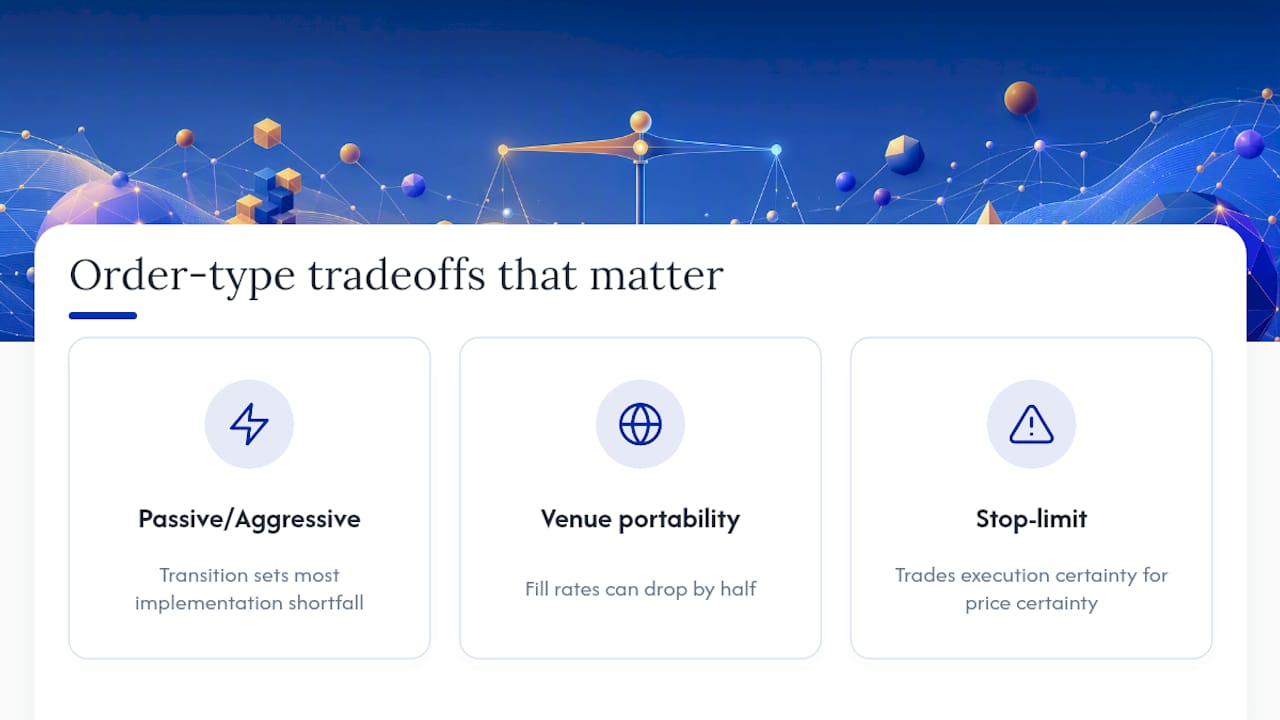
The passive/aggressive mix is the single most consequential parameter in any execution algo. Getting the order type right at the level of “limit vs. market” is table stakes. The real question is: at what point in each slice window does the algo switch from passive limit posting to aggressive IOC sweeping? That transition point determines most of the implementation shortfall. Set it too early and you pay the spread on every slice. Set it too late and you miss fills and accumulate timing cost.
The second underappreciated point is venue portability. Pegged orders, midpoint pegs, and post-only modifiers are not universal. An algo that relies on midpoint pegs for its passive fill rate will behave completely differently on a venue that does not support them, defaulting to plain limit orders that sit at a fixed price rather than floating with the quote. Builders who test on one venue and deploy on another without capability detection often see fill rates drop by half.
The third point is about stop-limit orders specifically. They are not a safer version of stop-loss orders. They are a different risk profile: you trade the certainty of execution for the certainty of price. In a fast market or a gap scenario, a stop-limit order can leave you holding a losing position indefinitely. Use them only when your strategy’s logic explicitly accounts for the possibility of non-execution, and always backtest them against historical gap data before deployment.
Build and test your order-type strategy with Quantgenie
The order-type recipes and backtesting methodology described in this article require a testing environment that can replay market data deterministically, simulate venue-specific order behavior, and let you sweep parameters without writing code.
Quantgenie translates plain-English strategy descriptions into deterministic algorithms, then runs them against institutional-grade historical market data. You can test an iceberg-plus-POV recipe, a VWAP participation strategy, or a bracket entry with OCO exits, and get the same results every time you run the same configuration. The platform’s performance metrics cover implementation shortfall, slippage per child order, and fill rate across volatility regimes — the exact metrics this article recommends tracking.
For builders ready to move from theory to tested execution logic, start building on Quantgenie and run your first deterministic backtest without writing a single line of code.
Sources
The following sources informed the definitions, trade-off analysis, and risk guidance in this article.
- Investor
- Market Orders vs. Limit Orders: Key Differences and When to Use Each | Investopedia
- Order types | FINRA
- The Plays: Order Types and Algorithms | Interactive Brokers (IBKR Campus)
- Stock order types (Vanguard Investor Education)
- Trading Up-Close: Stop and Stop-Limit Orders | Charles Schwab
This article is general educational information, not investment or trading advice. Confirm current exchange rules, order type availability, and regulatory requirements with your broker or a qualified financial professional before deploying any execution algorithm.