
Pattern Day Trader Rule: What Changes in 2026 for Traders

FINRA replaced the pattern day trader rule and its $25,000 minimum equity requirement with intraday margin standards. The new rules took effect June 4, 2026, and brokers have until October 20, 2027 to fully implement them. If you trade on margin, your account experience may shift before that deadline depending on which broker you use.
Here is what matters right now:
- No more PDT designation. The trade-count PDT designation and $25,000 minimum are gone under the new intraday margin standards.
- Intraday margin replaces the old framework. Buying power is now tied to your real-time intraday exposure, not a prior-day closing balance.
- The 90-day freeze still exists. Repeatedly failing to cover intraday margin deficits can still lock you out of margin trading for 90 days.
- Broker timing varies. Your broker may still operate under the old PDT rules during the transition window, which runs through October 20, 2027.
- Cash accounts are not a free pass. Settled-funds rules and good faith violations still apply if you try to sidestep margin requirements by switching account types.
Effective date: June 4, 2026. Broker implementation window: up to 18 months (until October 20, 2027).
Table of Contents
- What was the pattern day trader rule?
- What exactly did FINRA and the SEC change?
- How intraday margin deficits work in practice
- Who is affected and what the numbers look like
- What major brokers have said about implementation
- A practical checklist to prepare your account now
- Key Takeaways
- The risk didn’t disappear — only the measuring stick changed
- Quantgenie helps you trade under the new margin rules
- Primary sources and further reading
What was the pattern day trader rule?
The pattern day trader rule was a FINRA regulation that designated any margin account customer as a “pattern day trader” if they executed multiple day trades within a short period, provided those trades represented a significant share of total trades in the account during that period. Once designated, the account required maintaining a minimum equity threshold, and trading was restricted to margin accounts only.
Under that framework:
- Day-trading buying power was calculated as four times the prior-day maintenance margin excess, giving active traders leverage but tying it to a static end-of-day figure.
- Special maintenance margin applied to day-trade positions, separate from standard overnight margin requirements.
- Broker discretion allowed firms to designate a customer as a pattern day trader even without hitting the four-trade threshold, if the broker had reasonable basis to believe the customer intended to day trade regularly.
The criticism was straightforward: the $25,000 floor was an arbitrary capital barrier that had nothing to do with the actual risk of a given trade. A trader with $24,999 in equity could be locked out of executing a low-risk, small-position scalp, while a trader with $25,001 could take on far more exposure with no additional scrutiny. Regulators and market participants argued for years that the rule measured activity volume rather than actual risk, which is exactly what FINRA’s new approach is designed to fix.
What exactly did FINRA and the SEC change?
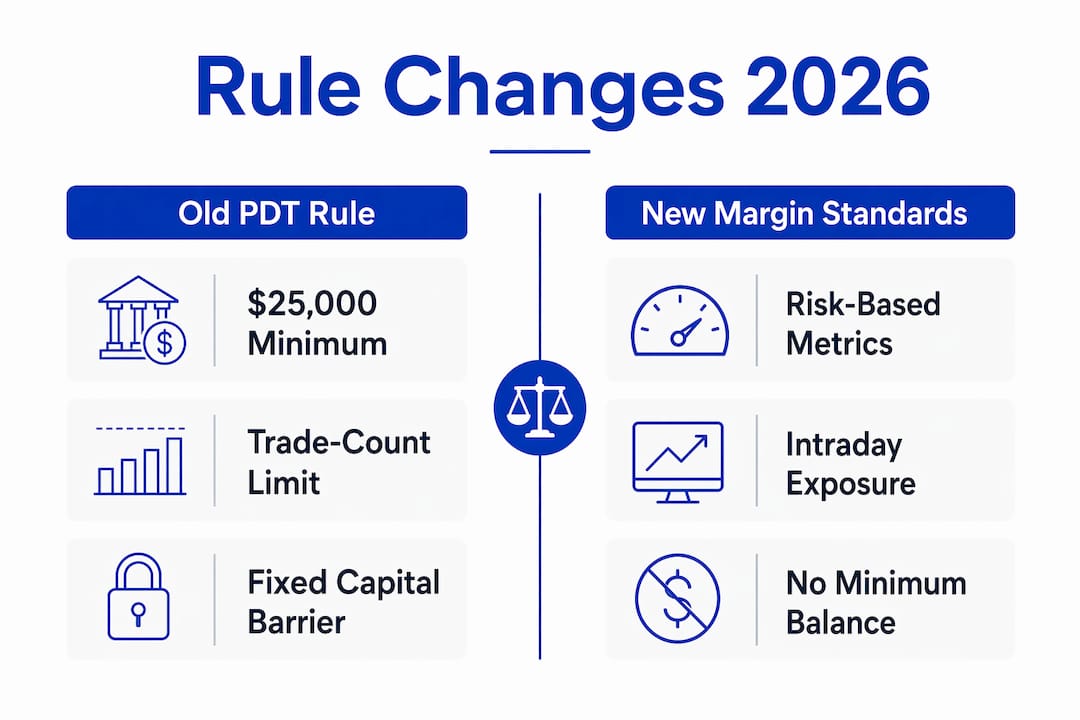
The new Rule 4210 intraday margin standards eliminate both the trade-count PDT designation and the $25,000 minimum equity requirement. What replaces them is a framework built around your actual intraday exposure at any given moment.
Key definitions under the new regime:
- Intraday margin level (IML): The minimum equity a customer must maintain relative to their open intraday positions.
- IML-reducing transactions: Trades that reduce your net intraday exposure and therefore lower your required margin.
- Intraday margin deficit: The shortfall when your account equity falls below the required intraday margin level for your open positions.
The effective date is June 4, 2026, with an 18-month transition window that lets member firms implement the new standards at their own pace, as long as they comply by October 20, 2027.
Before vs. after — what traders need to compare:
| Dimension | Old PDT Rule | New Intraday Margin Standards |
|---|---|---|
| What changed | Trade-count designation + $25,000 minimum | No PDT designation; intraday margin tied to real exposure |
| Effective date | Pre-June 2026 | June 4, 2026 (brokers until Oct 20, 2027) |
| Who is affected | Margin accounts with 4+ day trades in 5 days | All margin accounts with intraday positions |
| Buying power calculation | 4x prior-day maintenance margin excess | Real-time intraday margin excess |
| Monitoring and enforcement | End-of-day trade count; $25K equity check | Real-time or periodic intraday deficit checks |
| Practical trader action | Maintain $25K or limit to 3 day trades per 5 days | Monitor intraday exposure; avoid deficits; check broker policy |

The shift is explicitly risk-based by design. FINRA moved away from rigid trade-count metrics toward requirements tied to actual market exposure, which is a meaningful philosophical change even if the day-to-day mechanics feel similar for well-capitalized traders.
How intraday margin deficits work in practice

Understanding the mechanics here matters more than the regulatory language. Your broker will monitor your intraday margin exposure using one of several approaches, and the consequences of a deficit depend on how quickly it is detected and whether you cure it.
Monitoring approaches brokers may use:
- Real-time blocking: The system prevents a trade from executing if it would create an intraday margin deficit before the order goes through.
- Periodic checks: The firm reviews intraday exposure at set intervals during the trading day and issues a margin call if a deficit appears.
- End-of-day reconciliation: The firm calculates deficits after the close and contacts the customer to cure by a specified deadline.
Firms retain authority to impose house requirements that are stricter than FINRA’s baseline, and they will each publish written policies and procedures for how they handle deficits. That means your experience at one broker can differ significantly from another even under the same FINRA rules.
When a deficit occurs, the firm has three main options: demand a deposit to cover the shortfall, require you to liquidate positions to bring the account back into compliance, or impose a trading block until the deficit is cured. If you fail to satisfy deficits repeatedly and do not clear a deficit by the close of the fifth business day, the firm can impose a 90-day margin trading freeze. The one nuance worth knowing: minor deficits that fall below the lesser of 5% of your account equity or $1,000 generally do not count toward the pattern of failures that triggers the freeze.
A short flow example:
- You open an intraday position that pushes your exposure above your intraday margin level.
- Your broker detects the deficit, either in real time or at the next check interval.
- The broker notifies you and gives you a window to deposit funds or reduce the position.
- If you cure it, no freeze. If you fail to cure it by the fifth business day, the clock starts on a potential 90-day restriction.
Pro Tip: Set a personal intraday exposure limit well below your broker’s IML threshold. Leaving a buffer of 15–20% between your actual exposure and the margin level gives you room to absorb price moves without triggering a deficit.
Who is affected and what the numbers look like
The new rules apply to margin accounts. Cash accounts are not subject to intraday margin requirements, but they are not a clean workaround either. Cash account traders must use settled funds, and T+1 settlement timing creates its own constraints. A good faith violation, where you buy and sell a security before the proceeds from a prior sale have settled, can result in a 90-day restriction on cash purchases. Switching to a cash account to avoid margin rules often catches traders off guard for exactly this reason.
Three trader profiles and how the change hits them:
-
Small retail scalper on margin with $10,000. Under the old PDT rule, this trader was locked out of more than three day trades per five-day window without hitting the $25,000 minimum. Under the new regime, there is no trade-count cap. The constraint is intraday margin exposure. If the scalper keeps positions small relative to account equity, the new rules are actually less restrictive. The risk is overconfidence: more trades are allowed, but each one still carries margin exposure.
-
Swing trader with $50,000 in a margin account. This trader was above the old $25,000 threshold and had four times the prior-day maintenance margin excess as buying power. Under the new rules, buying power is calculated from real-time intraday margin excess rather than a prior-day figure. For a well-managed account, the practical difference is modest. The bigger change is that the broker is now watching intraday exposure continuously, not just checking a trade count at the end of the day.
-
Active trader near the $25,000 threshold. This is where the change is most significant. Previously, a trader with $24,500 was effectively barred from day trading in a margin account. Under the new standards, that trader can execute intraday trades as long as the positions stay within the intraday margin level. The $25,000 floor is gone.
The 90-day freeze scenario:
Suppose a trader opens three intraday positions in a single session, each sized aggressively. The combined exposure creates a $1,500 deficit against the intraday margin level. The broker notifies the trader. The trader does not deposit funds or reduce positions within the required window. That counts as one failure. If the pattern repeats and the trader fails to cure deficits by the close of the fifth business day on multiple occasions, the broker can impose the 90-day freeze. Note that a $900 deficit in a $20,000 account would fall under the safe harbor threshold (5% of $20,000 is $1,000, and $900 is less than that), so it would not count toward the pattern.
What major brokers have said about implementation
Brokers have until October 20, 2027 to comply, and they are not moving in lockstep. The practical effect is that two traders at different firms may have very different experiences during the transition window.
What public statements show:
- Charles Schwab has acknowledged the rule change and indicated it is reviewing its systems and policies to align with the new intraday margin standards. Schwab has historically maintained house requirements above FINRA minimums, so traders should expect its implementation to reflect those stricter baselines.
- E*TRADE has published guidance noting that buying power calculations will shift from prior-day excess measures to real-time intraday margin excess, and that the PDT designation will be eliminated as part of the transition.
- Other brokers have not yet published detailed implementation timelines, which is consistent with the 18-month window FINRA provided.
The variance in broker systems matters. A firm using real-time blocking will prevent deficit-creating trades before they execute. A firm using end-of-day reconciliation will let the trade go through and contact you afterward. Neither approach violates FINRA’s rules, but the trader experience is completely different. One protects you from yourself; the other puts the responsibility squarely on you to monitor your own exposure.
What to ask your broker right now:
- Has your firm adopted the new intraday margin standards, or is it still operating under the old PDT rules during the transition?
- Does your firm use real-time blocking, periodic checks, or end-of-day reconciliation for intraday deficits?
- What are your firm’s house requirements for intraday margin, and how do they differ from FINRA’s baseline?
- How will the firm notify you of a deficit, and what is the cure window?
A practical checklist to prepare your account now
Getting ahead of this change means doing a few concrete things before your broker flips the switch.
Immediate actions:
- Confirm whether your account is a margin account or a cash account, and understand which rules apply to each.
- Contact your broker to find out whether it has already implemented the new intraday margin standards or is still operating under the old PDT framework.
- Review your broker’s published intraday margin policy and house requirements. If none are published yet, ask directly.
- Check the SEC’s Investor.gov page for the official summary of the change and links to FINRA’s regulatory notice.
Operational preparation:
- Tighten position sizing so your intraday exposure stays well below the intraday margin level, not just at it.
- Enable pre-trade buying-power checks if your platform supports them. Knowing your available intraday margin before entering a trade is the simplest way to avoid a deficit.
- Set stop-losses or auto-liquidation rules on intraday positions to reduce the chance that a moving market creates a deficit you did not anticipate.
- Review your tax situation. Margin trading costs and tax implications are unchanged by the new rules, and interest on margin borrowing still accrues.
Risk tooling:
- Backtest intraday strategies under simulated margin constraints before trading them live. A strategy that looks clean on paper may create repeated deficit conditions in real market conditions.
- Paper-trade under your broker’s intraday margin parameters to see how your buying power behaves across different market scenarios.
- Set alerts for intraday margin exposure levels, not just account balance. The two are not the same.
Pro Tip: Algorithmic guardrails, specifically pre-trade checks built into a backtested strategy, are the most reliable way to prevent impulsive position sizing that creates deficits. A rule that says “do not enter if intraday exposure exceeds X” enforced by code is harder to override in the heat of a trade than a mental note. Tools like Assymetrix’s historical data API can help you validate those guardrails against large-scale price history before you go live.
Key Takeaways
The 2026 FINRA rule change eliminates the $25,000 PDT minimum and trade-count designation, replacing them with intraday margin standards that tie your buying power and risk exposure to real-time account activity rather than arbitrary thresholds.
| Point | Details |
|---|---|
| PDT rule eliminated | The $25,000 minimum and trade-count designation are gone as of June 4, 2026. |
| Intraday margin replaces it | Buying power is now based on real-time intraday margin excess, not prior-day closing figures. |
| 90-day freeze still applies | Repeatedly failing to cure intraday deficits by the fifth business day can trigger a 90-day margin trading restriction. |
| Broker timing varies | Firms have until October 20, 2027 to implement; your broker may still use the old PDT rules during the transition. |
| Quantgenie for preparation | Quantgenie’s no-code backtesting and pre-trade checks let you simulate intraday margin scenarios before trading live. |
The risk didn’t disappear — only the measuring stick changed
The conventional take on this rule change is that it is a win for retail traders. No more $25,000 barrier. No more counting day trades. More freedom. That framing is not wrong, but it misses the more important point.
The old PDT rule was blunt, but it had an accidental benefit: it forced undercapitalized traders to slow down. The $25,000 floor was arbitrary, but it also meant that someone with $8,000 in a margin account could not blow through six intraday positions in a day and wipe out their equity before they understood what happened. The new regime removes that speed bump and replaces it with something more sophisticated — and more demanding of the trader.
Intraday margin standards require you to understand your exposure in real time, not just your account balance. A trader who does not know the difference between their cash balance and their intraday margin excess is going to find out the hard way when a deficit notice arrives. The 90-day freeze is not a theoretical risk; it is the mechanism FINRA built specifically for traders who repeatedly fail to cure intraday margin deficits by the close of the fifth business day on multiple occasions.
The traders who will benefit most from this change are the ones who already had disciplined risk management. For everyone else, the new rules are not more forgiving. They are more precise, which means the consequences of imprecision are more immediate. Backtesting your strategies under realistic intraday margin conditions, and using pre-trade checks that enforce position limits automatically, is not optional preparation. It is the baseline competency the new framework assumes you have.
Quantgenie helps you trade under the new margin rules
The shift to intraday margin standards puts real-time exposure management at the center of every trade decision. Quantgenie is built for exactly that kind of preparation.

With Quantgenie’s no-code algorithm builder, you can describe your intraday strategy in plain English and get a deterministic, backtested algorithm that enforces position-sizing rules automatically. The platform’s institutional-grade backtesting lets you simulate how your strategy behaves under intraday margin constraints before you risk a single dollar live. Pre-trade checks can be built directly into your algorithm, so the system flags or blocks a trade that would push your exposure past a defined threshold. For traders who want to explore AI-powered trading tools that support this kind of systematic risk management, Quantgenie is a practical starting point.
The 90-day freeze is avoidable. The key is knowing your intraday exposure before you enter, not after. Try Quantgenie to build and backtest your intraday strategies under the new margin regime.
This article is general information, not financial or legal advice. Confirm current rules and how they apply to your specific account with your broker or a qualified financial professional.
Primary sources and further reading
These are the authoritative sources for the rule text, investor guidance, and broker implementation details referenced throughout this article.
- FINRA Regulatory Notice 26-10 — The primary rule text for the new intraday margin standards. Contains the effective date (June 4, 2026), the 18-month implementation window, and the full regulatory language replacing the PDT provisions. Start here.
- FINRA Investor Insight: Understanding the New Intraday Margin Requirements — Plain-language guidance from FINRA explaining what changed, how intraday margin works, and what traders should ask their brokers. Published alongside the regulatory notice.
- FINRA Investor Insight: Frequent Intraday Trading — Covers monitoring approaches, the 90-day freeze mechanics, and the safe harbor for minor deficits. Useful for understanding enforcement.
- SR-FINRA-2025-017 — The underlying rule filing that contains the technical detail on intraday margin deficit calculations, the safe harbor threshold (lesser of 5% of equity or $1,000), and the 90-day freeze trigger.
- Investor.gov — Pattern Day Trader — The SEC’s Investor.gov page summarizing the change in plain terms, with links to FINRA’s notice and investor guidance. Good reference for the official government summary.
- E*TRADE — Pattern Day Trader Rule Change — E*TRADE’s public explanation of how the transition affects buying power calculations and account operations. Representative of how major brokers are communicating the change.
- FINRA Day Trading Basics — Background on day trading mechanics, cash account rules, and good faith violations. Relevant for traders considering switching account types.