
Smart Order Routing: How It Works and Why It Matters

What is smart order routing and why does it exist?
Smart order routing (SOR) is an automated execution technology that splits a single parent order into multiple child orders and sends them simultaneously across fragmented US equity and options markets to achieve the best available execution. The core problem it solves: the same stock trades on dozens of venues at once, with different prices, different liquidity depths, and different fee structures. Without SOR, a trader manually picking one exchange leaves real money on the table.
The US market structure makes SOR a practical necessity, not a luxury. SEC Regulation NMS introduced the Order Protection Rule, which prohibits trading through better-priced protected quotes on any other venue. That rule alone forces any compliant broker-dealer to consult every protected venue’s top of book before executing. Add dark pools, alternative trading systems, and internalizers into the mix, and manual routing becomes genuinely unworkable at scale.
Key features and regulatory drivers at a glance:
- Routes child orders across lit exchanges, dark pools, and ATSs simultaneously
- Targets the National Best Bid and Offer (NBBO) as the price floor for execution
- Complies with SEC Reg NMS Order Protection Rule by checking all protected quotes
- Governed by FINRA Rule 5310 best execution obligations
- Balances price, liquidity, fees, speed, and fill probability in real time
Table of Contents
- How SOR algorithms actually route your orders
- What US regulations require from SOR systems
- Common misconceptions about intelligent order routing
- How Quantgenie lets you build and backtest SOR-informed strategies without code
- Real-world impact of dynamic order routing in US markets
- How SOR differs across asset classes and trading venues
- Risks and limitations of SOR, and how to manage them
- Quantgenie gives you institutional-grade strategy testing without a quant team
- Key Takeaways
How SOR algorithms actually route your orders
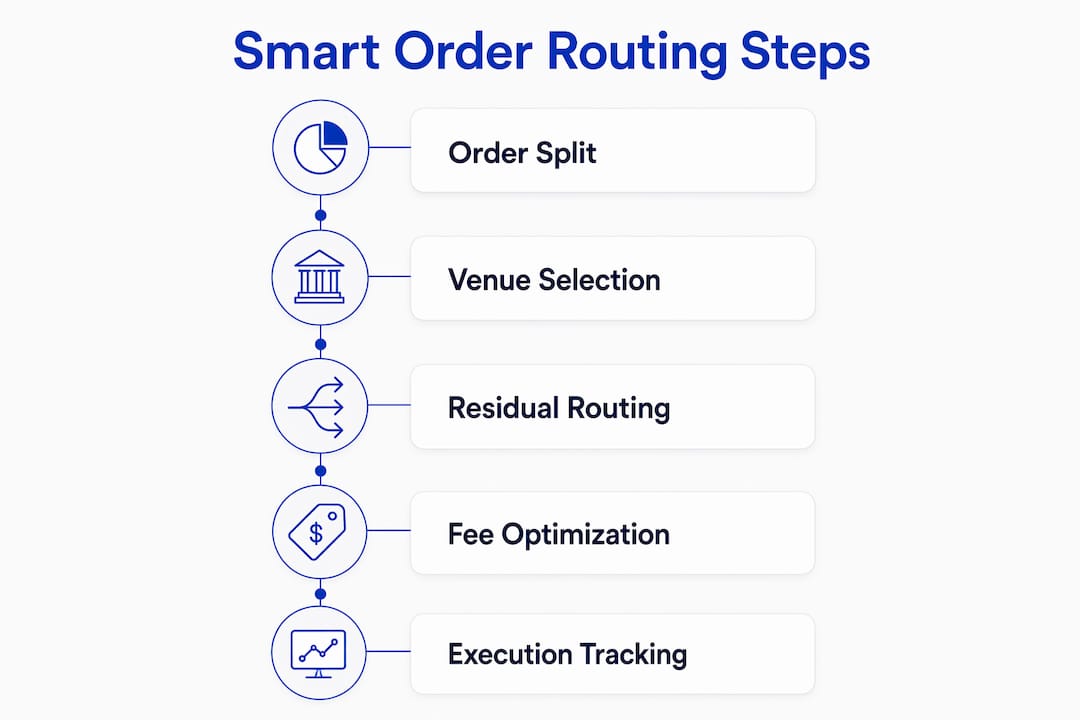
The mechanics are tighter than most traders realize. A SOR system first snapshots consolidated order books across all target venues, then divides the parent order into child orders sized to the displayed liquidity at each venue. Those child orders go out within 1–5 milliseconds, fast enough to capture resting liquidity before it moves.
Two main routing approaches exist, and each has a real tradeoff:
- Spray routing: sends child orders to multiple venues simultaneously. Fast, but it broadcasts intent. A visible order across five venues at once can tip off HFT participants.
- Sequential routing: sends to the best venue first, then routes residuals. Reduces information leakage but risks stale quotes by the time the second order lands.
After the initial spray, unfilled residuals typically route to dark pools for midpoint execution, which avoids crossing the spread entirely. If dark pools fail to fill, the router posts resting limit orders and uses probabilistic or machine learning models to rank venues by historical fill quality.
Fee structure is not a footnote. SOR routers incorporate venue rebates and toxicity metrics to optimize net-of-fee execution, not just raw displayed price. A venue offering a slightly worse displayed price but a large maker rebate can produce a better net outcome than the venue showing the best quote.

Pro Tip: Track your fills by venue over time. If one venue consistently shows a large markout (price moves against you immediately after the fill), your router may be sending too much flow there. Good routers down-weight toxic venues automatically, but you should verify.
What US regulations require from SOR systems
FINRA Rule 5310 is the governing standard for best execution in the US. It requires broker-dealers to conduct regular and rigorous independent reviews of order routing execution quality. Critically, a broker-dealer cannot transfer this duty to another firm. If you outsource your routing, you still own the obligation to verify it is working.
“A broker-dealer must not allow payment for order flow to interfere with its efforts to obtain best execution. Obtaining price improvement is a heightened consideration when a broker-dealer receives payment for order flow.” — SEC Proposed Rule on PFOF and Best Execution
The SEC’s proposed Regulation Best Execution would codify a formal best execution standard requiring broker-dealers to establish written policies identifying material liquidity sources and documenting how they determine the best market for each order type. That rulemaking reflects ongoing SEC concern that payment for order flow (PFOF) creates structural conflicts of interest in routing decisions.
Practical compliance obligations for broker-dealers using SOR:
- Maintain written policies and procedures for order handling and venue selection
- Conduct periodic, documented reviews of execution quality by venue
- Assess price improvement opportunities, especially when receiving PFOF
- Supervise routing logic and document any changes to venue-ranking algorithms
- Never treat reliance on a third-party router as a substitute for independent review
Common misconceptions about intelligent order routing
The biggest myth: SOR is always smarter than a human. Vortex Capital Group’s desk analysis is direct about this. On SPY, the first 15 minutes of the cash session carry roughly 251K shares per minute of average volume with a 4.92 bp per-minute range. The midday window drops to 57K–80K shares per minute. Same security, completely different routing problem. A router optimized for fragmented liquidity access during midday is the wrong tool at the open, where queue position and information leakage matter more than venue breadth.
Misconceptions versus realities:
| Misconception | Reality |
|---|---|
| SOR always finds the best price | SOR optimizes net-of-fee cost, not just displayed price |
| Dark pools always improve fills | Toxic dark pool liquidity causes adverse selection; good routers avoid it |
| Spray routing is always fastest | Speed comes with information leakage risk in thin or sensitive names |
| Sequential routing avoids all leakage | Stale quotes between child orders can cost more than leakage |
| Manual routing is always inferior | Queue-sensitive and urgency-driven trades often need manual override |
The millisecond timing gap between child orders matters more than traders expect. A 3 ms delay between the first and second child order is enough for a fast participant to lift the quote the second order was targeting.
Pro Tip: After each session, review fills by time-of-day and venue. If your worst fills cluster at the open or close, consider whether manual routing or explicit order type selection (ISO, peg-to-mid, MOC) would have served those specific windows better.
How Quantgenie lets you build and backtest SOR-informed strategies without code
Understanding SOR mechanics is one thing. Testing whether a specific routing logic actually improves your strategy’s performance requires backtesting, and most backtesting tools require you to write code. Quantgenie removes that barrier entirely.
The platform lets traders describe their strategies in plain English. Quantgenie’s natural language processing translates those descriptions into deterministic algorithms, meaning the same strategy produces identical results every time under the same conditions. That reproducibility matters enormously when you are testing SOR-informed logic, because inconsistent outputs make it impossible to isolate what is actually driving performance.
“QuantGenie offers a no-code platform enabling building, backtesting, and AI-assisted refinement of algorithmic trading strategies with institutional-grade market data and deterministic outputs.” — QuantGenie Platform
Features directly relevant to SOR strategy development:
- Natural language to algorithm translation: describe multi-venue execution logic without writing a single line of code
- Validated market data: institutional-grade historical data for backtesting, not synthetic fills
- AI-assisted analysis: ask questions about your backtest results in plain English and get specific answers
- Portfolio risk analysis: assess how routing decisions affect overall portfolio exposure
- Historical robustness testing: stress-test strategies across different market regimes
For traders who want to model how venue selection, order splitting, or timing rules affect execution quality, Quantgenie provides the infrastructure that previously required a quant team.
Real-world impact of dynamic order routing in US markets
The practical difference SOR makes shows up most clearly in large-cap equities and ETFs, where liquidity is genuinely fragmented across a dozen or more venues. A 10,000-share order in a liquid name like SPY might find 2,000 shares on NYSE Arca, 1,500 on NASDAQ, 800 on CBOE, and meaningful midpoint liquidity in several dark pools. A router that checks all of them simultaneously and fills at the midpoint where possible consistently outperforms a single-venue execution on net-of-fee cost.
The impact is less obvious but equally real in listed options. The SEC’s analysis found that in the first quarter of 2022, wholesalers paid more than $796 million to retail broker-dealers for order flow in NMS stocks and listed options, with listed options representing roughly 70% of that total. That scale of PFOF creates structural pressure on routing decisions, which is exactly why the SEC’s proposed Regulation Best Execution targets it directly.
How SOR differs across asset classes and trading venues
SOR implementations vary significantly depending on the asset class and venue type.
US equities: The most mature SOR environment. Reg NMS creates a clear legal framework, protected quotes are well-defined, and venue fee schedules are publicly disclosed. Routers here compete primarily on latency, venue-ranking sophistication, and dark pool access quality.
Listed options: More complex. Each underlying has options trading on multiple exchanges with different market maker obligations and fee structures. SOR in options must account for wide bid-ask spreads, lower liquidity per strike, and the fact that midpoint fills are less common than in equities.
Fixed income and futures: SOR is less standardized. Treasury futures on CME are relatively centralized, reducing the fragmentation problem. Corporate bonds trade OTC with significant venue fragmentation but less regulatory prescription than equities.
Dark pools vs. lit venues: Lit exchanges provide price discovery and transparency. Dark pools offer midpoint execution and reduced market impact, but at the cost of potential adverse selection if the pool attracts toxic flow. Effective routers use historical markout data to score each dark pool and adjust allocation accordingly.
Risks and limitations of SOR, and how to manage them
SOR is not a set-and-forget solution. The risks are real and specific.
Information leakage is the primary risk with spray routing. Sending visible child orders to multiple lit venues simultaneously signals your intent to fast participants who can front-run the residual fills. Mitigation: use hidden order types, peg-to-midpoint orders, or route residuals to dark pools first.
Stale quotes affect sequential routing. By the time the second or third child order reaches its target venue, the quote may have moved. Mitigation: set aggressive cancel-and-replace logic and use immediate-or-cancel (IOC) order types for child orders.
Venue toxicity builds up silently. A router that does not track markout by venue will keep sending flow to venues where fills consistently precede adverse price moves. Mitigation: review venue-level fill quality monthly and verify your router’s toxicity-weighting logic is active.
Over-reliance on automation is the subtler risk. As Vortex Capital Group notes, a correct trade routed badly is one of the most common failure modes traders never journal. SOR cannot know your urgency, your queue sensitivity, or your footprint concerns. Those require human judgment.
Regulatory risk is ongoing. The SEC’s proposed Regulation Best Execution, if finalized, will impose stricter documentation and review requirements on broker-dealers. Traders using third-party routing should verify their broker’s compliance posture now, not after enforcement actions begin.
Quantgenie gives you institutional-grade strategy testing without a quant team
Most traders who understand SOR well enough to want to test routing-informed strategies hit the same wall: the tools capable of modeling multi-venue execution logic require Python, C++, or a dedicated quant. Quantgenie is built specifically for traders and analysts who want institutional-grade backtesting without that dependency.
You describe your strategy in plain English. Quantgenie translates it into a deterministic algorithm, runs it against validated historical market data, and gives you AI-assisted analysis of the results. Every backtest is reproducible. Every performance metric is grounded in real data. You can test how timing rules, venue preferences, or order-splitting logic affect your strategy’s risk-adjusted returns before committing a single live dollar.
Start building your first algorithm on Quantgenie today, no coding required.
Key Takeaways
Smart order routing optimizes trade execution by splitting parent orders into child orders routed across fragmented venues, balancing net-of-fee cost, liquidity, and speed under strict US regulatory obligations.
| Point | Details |
|---|---|
| SOR targets net-of-fee cost | Raw displayed price ignores venue rebates and fees; effective routing optimizes the total net outcome. |
| FINRA Rule 5310 is non-delegable | Broker-dealers must independently review routing quality; outsourcing the router does not transfer the duty. |
| Manual override has a place | Urgency, queue sensitivity, and information leakage concerns often require human judgment over automated routing. |
| Venue toxicity requires monitoring | Routers that do not track markout by venue silently degrade fill quality over time. |
| Quantgenie enables no-code backtesting | Traders can model and test SOR-informed strategies using plain English and institutional-grade validated data. |