
Tick Data Backtesting: A Practitioner’s Complete Guide

Tick data backtesting is the most accurate method for validating trading strategies against historical market conditions. Where bar data collapses price action into four summary values per interval, tick data preserves every individual trade and quote with millisecond timestamps, capturing the actual sequence of market events. That sequence is what determines whether your strategy’s fills are real or fictional.
The difference is not academic. A gold scalping EA tested on 1-minute OHLC data appeared highly profitable, but the same EA run on real tick data showed significant losses, indicating the OHLC model was handing out fills at prices that never existed. Same code, same period, opposite conclusion. The OHLC model was handing out fills at prices that never existed.
- Tick data captures every bid, ask, trade price, volume, and timestamp at millisecond resolution
- Bar data (OHLC) compresses all of that into four prices per interval, discarding the path
- The “intrabar path” fallacy occurs when stops or take-profits trigger inside a bar, and the model guesses the sequence
- Tick data eliminates that guess, producing fills that reflect what the market actually did
- Latency modeling, queue position simulation, and spread analysis all require tick-level data
Pro Tip: Not every strategy needs tick data. If your entries and exits fire on bar closes with wide ATR-based stops, OHLC is a legitimate and faster way to run optimizations. Reserve tick data for strategies where timing inside a bar actually changes the outcome.
Table of Contents
- What historical tick data actually looks like
- Why bar data backtesting fails certain strategies
- Where tick data backtesting delivers the most value
- Common mistakes in tick data backtesting
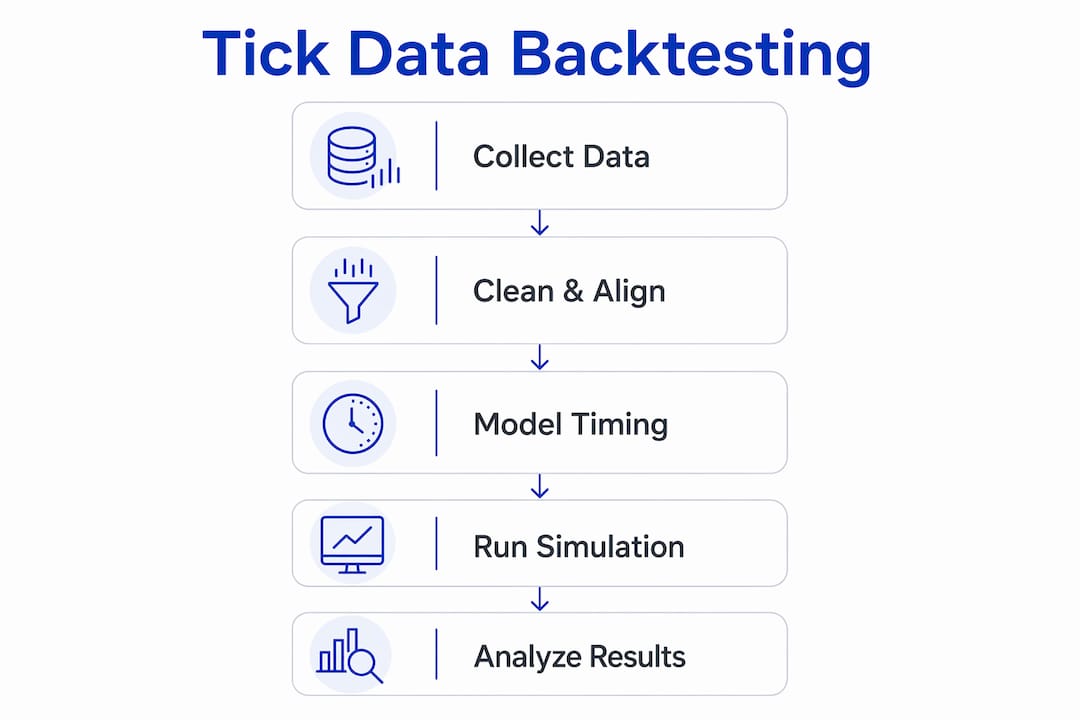
- How to model timing accurately in a tick backtest
- Best practices for deterministic, reliable tick backtesting
- Regulatory considerations for U.S. algorithmic traders
- Integrating tick data with order book information
- Quantgenie gives you institutional-grade backtesting without the infrastructure burden
- Key Takeaways
What historical tick data actually looks like
Tick data is the raw market feed: every individual quote timestamped to the millisecond, with bid price, ask price, and volume. Nothing is aggregated. A single active forex pair can generate millions of ticks per day, compared to 1,440 one-minute bars covering the same period.
Each tick record typically contains:
- A timestamp (millisecond or microsecond precision)
- Bid and ask prices at that moment
- Last trade price and volume where available
- Quote updates reflecting order book changes
The structural difference from OHLC is fundamental. Bar data tells you where price opened, peaked, roughed, and closed within a fixed window. Tick data tells you the order in which those things happened. For strategies that care about sequence, that distinction is the whole game.
Storage is a real constraint. BTC/USD book depth data generates over 2,000 data points per minute on Coinbase, compared to 60 points for a 1-minute bar feed from Binance. Multiply that across multiple instruments and years of history, and you are managing terabytes, not gigabytes.
Why bar data backtesting fails certain strategies
The core problem with OHLC data is that it cannot tell you whether the high or the low of a bar came first. When a stop-loss and a take-profit both sit inside the same one-minute bar’s range, the backtesting engine has to guess which one was hit. Guess wrong enough times and a viable strategy looks dead. Guess right and a losing strategy looks profitable.

This is the intrabar path fallacy, and it cuts in both directions. A gold breakout EA that blew up under 1-minute OHLC testing was actually profitable with a profit factor around 1.3 when run on real ticks across two different brokers’ histories. The OHLC model was killing a real edge.
Bar data also cannot model:
- Spread and slippage at the quote level, since bid-ask data is discarded
- Queue position for limit orders, which depends on the sequence of events
- Latency effects, since all fills within a bar are treated as simultaneous
- Realistic partial fills and order book dynamics
Bar-based backtesting systematically overstates the profitability of high-frequency strategies because it cannot simulate the queue position that determines whether a maker order actually fills.
Where tick data backtesting delivers the most value
Tick data is not universally necessary. The strategies that genuinely require it share a common trait: the outcome depends on what happened inside a bar, not just at its close.
- Scalping and high-frequency strategies that open and close within minutes, where the intrabar path determines every fill
- Grid trading systems with tight take-profits, where OHLC interpolation hands out fills at prices the market never touched
- Spread and slippage modeling, which requires actual bid-ask quote data rather than a single mid-price
- Limit order strategies where queue position determines fill probability, making tick-level order book reconstruction necessary
- Custom candle construction, such as volume bars or range bars, which require raw tick data to build correctly
- Market microstructure research, including order flow analysis and liquidity modeling
- Event-driven strategies that react to specific trade prints rather than bar closes
For swing trading, position trading, or any strategy that signals on daily closes, OHLC data is sufficient. Adding tick resolution to a daily-bar system introduces noise without improving accuracy.
Common mistakes in tick data backtesting
The most expensive mistake is assuming that more granular data automatically produces better results. Tick data introduces noise, and strategies that overfit to that noise will fail in live trading.
- Ignoring latency entirely: Running a tick-level backtest without modeling feed delay and order submission time produces fills that could never occur in practice
- Lookahead bias in data pipelines: Processing tick data out of chronological order, or using future ticks to inform current decisions, inflates results in ways that are hard to detect
- Insufficient data cleaning: Raw tick feeds contain outliers, duplicate timestamps, zero prices, and stale quotes. Running a backtest on uncleaned data produces garbage results
- Infrastructure underestimation: Teams often underestimate the storage, memory, and processing requirements until they are mid-project with incomplete pipelines
- Using tick data when bar data suffices: A Donchian breakout EA with entries on bar closes and wide ATR stops produced essentially identical results under both tick and OHLC models, meaning the tick infrastructure added cost with no benefit
- Overfitting to microstructure noise: Tick data contains patterns that are artifacts of market mechanics, not exploitable edges
How to model timing accurately in a tick backtest
Timing is where most tick-level backtests fall apart. The sequence of events matters, but so does the delay between them. A strategy that submits an order at timestamp T does not get a fill at timestamp T. Feed latency, network delay, exchange processing, and queue position all add time.
Accurate tick-by-tick simulation requires modeling at least two distinct components:
- Local processor: Sees market data after feed latency, submits orders at the current simulation time, and receives responses after round-trip latency
- Exchange processor: Receives orders at the exchange timestamp plus entry latency, simulates fills based on queue position, and sends responses back after an additional response latency
Every event, including feed updates, order submissions, and exchange responses, must carry its own timestamp. The simulation engine processes events in strict chronological order across all assets and processors. Without this discipline, the backtest assumes fills that the exchange would never have granted.
Maintaining chronological order is not optional. Without strict event sequencing, backtests routinely overstate the profitability of high-frequency strategies by assuming fills at prices that had already moved by the time the order reached the exchange.

Best practices for deterministic, reliable tick backtesting
Reproducibility is the standard that separates a real backtest from a lucky run. A deterministic backtest produces identical results every time it runs on the same data, which is the only way to trust that a strategy’s performance reflects its logic rather than random variation.
| Criterion | Tick data | Bar (OHLC) data |
|---|---|---|
| Intrabar fill accuracy | Exact sequence preserved | Guessed by model |
| Spread and slippage modeling | Full bid-ask available | Mid-price only |
| Latency simulation | Possible with dual-processor model | Not applicable |
| Queue position modeling | Accurate | Not possible |
| Data volume | Very large (millions of ticks/day) | Compact |
| Noise level | High, requires cleaning | Low |
| Best for | HFT, scalping, limit-order strategies | Swing, position, bar-close strategies |
Key practices for building a reliable tick backtesting framework:
- Separate local and exchange simulation components to model latency and order book dynamics independently
- Use event-driven engines that process discrete market events in strict timestamp order
- Implement data validation pipelines that flag and remove zero prices, duplicate timestamps, and outlier ticks before the backtest runs
- Capture run metadata: config snapshots, data file hashes, and dependency versions so any run can be reproduced exactly
- Balance granularity against infrastructure: practitioners recommend carefully matching data resolution to computational capacity, since volume grows exponentially from bar to tick to full order book depth
Pro Tip: Run your strategy on both tick and OHLC data before committing to a tick-only pipeline. If the results diverge sharply, tick data is mandatory. If they agree closely, OHLC may be sufficient and will save you significant infrastructure cost.
Quantgenie’s deterministic backtesting platform applies these principles without requiring traders to build the infrastructure themselves. Strategies described in plain English are translated into reproducible deterministic algorithms, tested against validated institutional-grade market data, and produce identical results on every run.
Regulatory considerations for U.S. algorithmic traders
Algorithmic traders operating in the United States work within a regulatory framework that directly affects how backtests must be designed and documented. The SEC and FINRA both require that firms using algorithmic strategies maintain records of their testing methodologies, including the data sources and assumptions used.
For strategies trading equities, the SEC’s Regulation NMS requires that execution modeling account for the National Best Bid and Offer (NBBO), which means tick-level quote data from consolidated feeds is necessary for accurate fill simulation. Futures traders fall under CFTC oversight, and the NFA’s compliance rules require that algorithmic trading systems be tested before deployment, with documentation of the testing process.
Firms registered as broker-dealers or investment advisers face additional obligations under SEC Rule 17a-4, which mandates retention of records related to trading systems and their testing. Using tick data in backtesting, and preserving those backtest records, supports compliance with these retention requirements. Traders should also account for market hours, exchange-specific session rules, and the impact of pre-market and after-hours tick data on strategy performance, since fill assumptions outside regular trading hours differ materially from intraday conditions.
Integrating tick data with order book information
Tick data alone captures trades and quotes, but the order book adds the depth dimension: how many contracts or shares are available at each price level, and how that depth changes with every new order, cancellation, or fill.
Combining tick data with Level 2 order book data enables:
- Queue position estimation: Knowing the depth ahead of your limit order at the time of submission lets the backtest model whether the order fills before the market moves away
- Adverse selection modeling: Order book imbalance at the moment of a trade is a strong predictor of short-term price direction, which affects whether a fill is favorable or not
- Liquidity analysis: Depth data reveals whether the size you intend to trade can be absorbed at the quoted price, or whether your order would move the market
The infrastructure cost of full order book data is substantially higher than trade-only tick data. As noted earlier, BTC/USD book depth at 10 levels generates over 2,000 data points per minute on Coinbase. For most strategies, top-of-book bid-ask data from the tick feed is sufficient. Full depth reconstruction is worth the overhead only for strategies that explicitly model queue dynamics or large-order execution.
Integrating these two data streams requires careful timestamp alignment. Order book snapshots and tick prints must share a common time reference, or the simulation will model fills against a book state that did not exist at the moment of the trade.
Quantgenie gives you institutional-grade backtesting without the infrastructure burden
Building a tick-level backtesting framework from scratch takes months and requires expertise across data engineering, execution modeling, and quantitative finance. Most traders spend more time on infrastructure than on strategy research.
Quantgenie takes a different approach. You describe your trading strategy in plain English, and the platform translates it into a deterministic algorithm tested against validated institutional-grade market data. Every backtest run produces identical results under the same conditions, so you are testing your strategy’s logic, not the noise in your pipeline. The platform includes comprehensive performance metrics, portfolio risk analysis, and AI-assisted interpretation of backtest results, all without writing a line of code.
For algorithmic and quantitative traders who want the precision of tick-level validation without building and maintaining the underlying infrastructure, Quantgenie is the direct path from strategy idea to deployment-ready algorithm. Start your first backtest at quantgenie.ai.
Key Takeaways
Tick data backtesting is the only reliable method for validating strategies where timing inside a bar determines fills, but it requires deterministic event sequencing, latency modeling, and rigorous data cleaning to produce trustworthy results.
| Point | Details |
|---|---|
| OHLC fill errors are severe | A gold scalping EA showed a profit factor of 2.46 on OHLC but 0.488 on real tick data. |
| Tick data is not always necessary | Strategies with bar-close entries and wide stops produce nearly identical results under both models. |
| Latency modeling is mandatory | Accurate tick backtests require separate local and exchange processors with distinct event timestamps. |
| Data volume is a real constraint | BTC/USD book depth generates over 2,000 data points per minute versus 60 for a 1-minute bar. |
| Quantgenie handles the infrastructure | Quantgenie delivers deterministic tick-level backtesting against validated institutional data, no code required. |