
Deterministic vs Stochastic: AI and Trading Explained

Deterministic systems produce the same output every time for the same input; stochastic systems include randomness and produce a distribution of possible outputs. The practical decision rule: choose deterministic when you need reproducibility and rule-based execution, choose stochastic when the problem involves irreducible uncertainty or requires modeling variability. In practice, most serious AI systems and trading pipelines use both — a deterministic core for reliable execution, with stochastic components layered in through tools like Markov decision processes, Monte Carlo sampling, or conditional AI advisory modules. Quantgenie’s approach to deterministic algorithm generation is a good applied example of that architecture.
Key Takeaways
Deterministic models are the right default; stochastic models earn their place only where irreducible uncertainty exists and must be quantified.
| Point | Details |
|---|---|
| Core distinction | Deterministic: same input always yields same output. Stochastic: same input yields a distribution of outputs. |
| Decision rule | Choose deterministic for reproducibility and rule-based execution; choose stochastic when the problem has irreducible uncertainty. |
| Hybrid architecture | Most production AI and trading systems use a deterministic core with stochastic modules behind clean interfaces. |
| Reproducibility practice | Seed every RNG, log seeds with results, and run stochastic models multiple times to report mean and standard deviation. |
| Applied trading context | Deterministic rules provide auditable backtests; stochastic or ML components add adaptability — ensembles of both often outperform either alone. |
Table of Contents
- What is the difference between deterministic and stochastic models?
- Cross-domain examples that build intuition
- How deterministic vs stochastic plays out in AI and reinforcement learning
- Advantages, disadvantages, and when to choose each approach
- Common misconceptions about randomness and model types
- Reproducibility, testing, and controlling randomness in practice
- Deterministic and stochastic approaches in algorithmic trading
- The case for starting deterministic and adding randomness deliberately
- Sources
What is the difference between deterministic and stochastic models?
A deterministic model is a function: given the same inputs and parameters, it always returns the same output. Formally, y = f(x). No randomness enters the mapping. A stochastic model introduces at least one random variable, typically written as y = f(x) + ε, where ε is a noise term drawn from some probability distribution. The Stats StackExchange thread on deterministic vs stochastic models puts it cleanly: a model is stochastic if it includes random variables; it is deterministic if outputs are fully specified by inputs and parameters.
That distinction has a precise parallel in reinforcement learning policy notation:
- Deterministic policy: π_d(s) = a — the policy maps each state s to exactly one action a.
- Stochastic policy: π_s(a|s) — the policy maps each state s to a probability distribution over possible actions.
Randomness enters models in a few distinct ways. In statistical forecasting, a stochastic trend allows the level or slope of a time series to shift because of random shocks, while a deterministic trend assumes a fixed slope throughout. In simulation, randomness enters through transition kernels — the probability that state s transitions to state s’ after action a. In language models, it enters through sampling procedures at decoding time.
| Dimension | Deterministic model | Stochastic model |
|---|---|---|
| Formal representation | y = f(x) | y = f(x) + ε, or P(y |
| Output given same input | Always identical | Drawn from a distribution |
| Randomness source | None | Noise term, transition kernel, or sampling |
| Reproducibility | Exact | Requires seeding to reproduce |
| Typical application | Rule-based systems, backtesting | Simulation, probabilistic forecasting, RL exploration |
One important clarification: heteroscedasticity is not the same as stochasticity. Heteroscedasticity means the variance of errors is non-constant across observations. That property can appear in both deterministic and stochastic models. Conflating the two is a common modeling error.
Cross-domain examples that build intuition
The cleanest way to internalize the difference is to run through examples where the classification is obvious, then work toward cases where it gets interesting.
- Chess: The rules are fully specified. Given a board position and a move, the resulting position is always the same. Chess is a deterministic environment. A chess engine playing the same position twice with the same algorithm produces the same move.
- Coin flip: Physically, a coin flip is deterministic — the outcome follows from initial conditions and physics. But those conditions are unobservable in practice, so the coin flip is modeled as stochastic. This is the key insight: stochasticity is often a modeling choice, not an ontological fact.
- Monte Carlo simulation: Explicitly stochastic. The method draws random samples from a distribution to estimate quantities that would be hard to compute analytically. The output is a distribution of results, not a single number.
- Deterministic trend in forecasting: A regression line fit to a time series assumes a fixed slope. The forecasting textbook distinction is instructive: a deterministic trend model says “the series grows by exactly β per period”; a stochastic trend model (like a random walk with drift) says “the growth rate itself wanders due to random shocks.”
- AR(1) process: An autoregressive model of order 1 is stochastic — the current value depends on the previous value plus a random error term. Remove the error term and you have a deterministic recurrence relation.
The pattern across these examples: if you can write down a function that takes inputs and returns a single output with no randomness, the system is deterministic. If the output requires drawing from a distribution, it is stochastic.
How deterministic vs stochastic plays out in AI and reinforcement learning
This is where the distinction gets practically important for engineers and researchers.
-
Policies in reinforcement learning. A deterministic policy π_d(s) = a is computationally simpler and easier to evaluate — run the policy twice in the same state, get the same action. A stochastic policy π_s(a|s) assigns probabilities to actions, which is necessary when the environment is partially observable or when exploration requires the agent to try different actions from the same state. GeeksforGeeks notes that stochastic policies are essential where observations are incomplete or environments are inherently random. Most real-world AI systems mix both: deterministic rules for base behavior and stochastic elements for uncertainty and exploration.
-
Environment transition functions. A deterministic environment means that taking action a in state s always leads to state s’. A stochastic environment means the next state is drawn from a transition kernel P(s’|s, a). This matters for planning: algorithms like value iteration assume you can enumerate transitions exactly; model-based RL in stochastic environments must estimate those transition probabilities from data.
-
LLM decoding. Greedy decoding is deterministic — the model always picks the highest-probability next token. Temperature sampling, top-k, and top-p (nucleus) sampling are stochastic — they draw from a distribution shaped by the model’s output logits. In production, deterministic decoding is preferred when consistency matters (customer-facing responses, automated pipelines). Stochastic decoding is preferred in research or creative generation where diversity of outputs is valuable.
-
Reproducibility and evaluation. Stochastic components make evaluation harder. A stochastic policy evaluated once gives you one data point; you need repeated runs and confidence intervals to characterize its performance. A deterministic policy evaluated once gives you the answer. This asymmetry has real consequences for experiment design: any benchmark that runs a stochastic model once and reports a single number is methodologically weak.
Pro Tip: When evaluating a stochastic model, run it at least 10–30 times with different seeds and report the mean and standard deviation of your metric. A single-run result for a stochastic system is not a result — it is a sample.
Advantages, disadvantages, and when to choose each approach
The choice between deterministic and stochastic approaches is not about which is “better” — it is about which fits the problem structure.
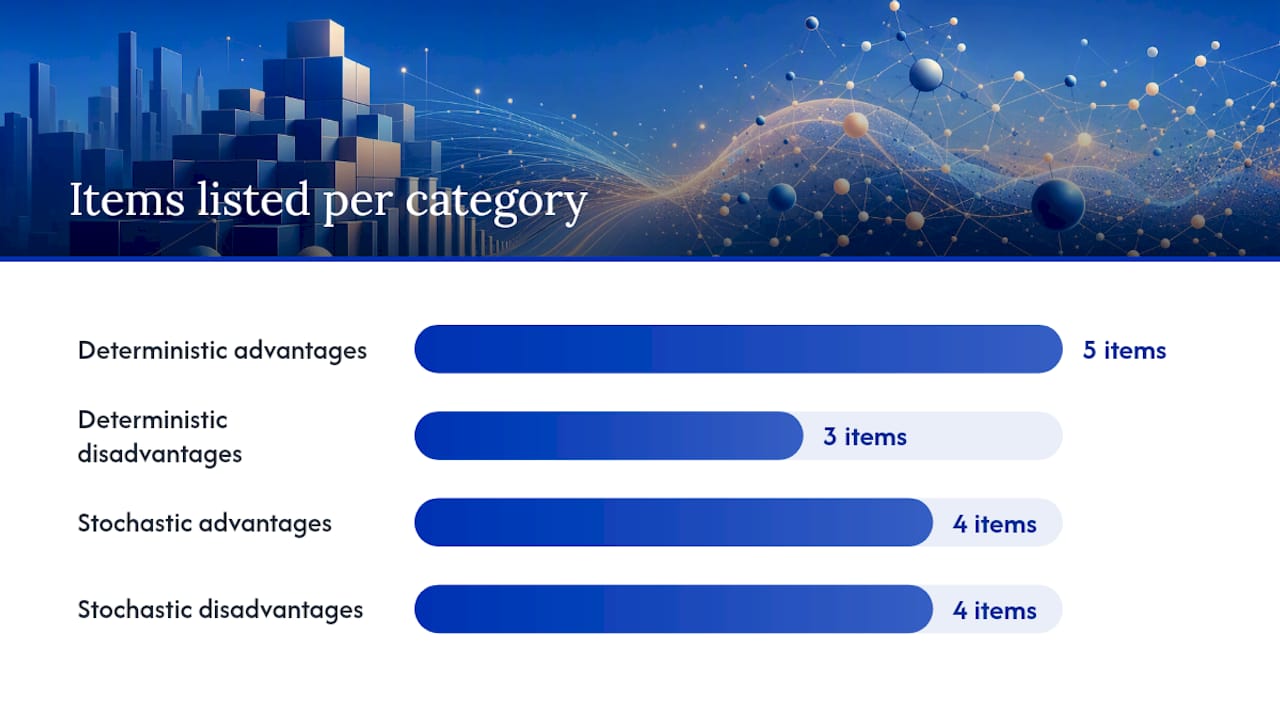
Deterministic advantages: exact reproducibility, lower computational cost per run, straightforward debugging, interpretable outputs, and easy unit testing. Deterministic disadvantages: cannot represent uncertainty in outputs, may be brittle when inputs fall outside the modeled range, and cannot explore a solution space without external randomization.
Stochastic advantages: can represent and quantify uncertainty, naturally handles environments with irreducible randomness, supports exploration in optimization and RL, and can model complex distributions that no closed-form function captures. Stochastic disadvantages: harder to reproduce, requires more runs to evaluate reliably, computationally heavier, and can be harder to debug when outputs vary unexpectedly.
| Dimension | Deterministic | Stochastic |
|---|---|---|
| Formal model | y = f(x) | y = f(x) + ε or P(y |
| Predictability | Exact same output every run | Distribution of outputs; seed-dependent |
| Typical use cases | Rule-based trading, unit testing, backtesting | Simulation, RL exploration, probabilistic forecasting |
| Advantages | Reproducible, fast, interpretable | Handles uncertainty, supports exploration |
| Disadvantages | Brittle at distribution edges, no uncertainty output | Harder to evaluate, computationally heavier |
| AI example | Greedy decoding, deterministic policy | Sampling-based decoding, stochastic policy |
| Trading example | Fixed threshold indicator rules | Probabilistic strategy selection, ML-based signals |
Decision checklist:
- Do you need exact reproducibility across runs? Go deterministic.
- Does the problem have irreducible uncertainty (market prices, sensor noise, partial observability)? Build in stochastic components.
- Are you writing unit tests for core logic? Test deterministically.
- Are you exploring a high-dimensional search space? Use stochastic search.
- Do you need to communicate uncertainty to stakeholders? Stochastic models give you that directly.
- Are you building a production system where debugging matters? Keep the core deterministic; isolate stochastic modules behind clean interfaces.
The Analytics Campus overview of deterministic vs stochastic in ML recommends hybrid approaches for most ML applications, and that recommendation holds up in practice.
Common misconceptions about randomness and model types
Myth: Stochastic means totally unpredictable. Fact: Stochastic models quantify uncertainty through probability distributions. A stochastic model does not say “anything could happen” — it says “here is the probability of each outcome.” A well-calibrated stochastic model is more informative than a deterministic one that ignores uncertainty.
Myth: Deterministic models mean no noise in reality. Fact: A deterministic model can be applied to noisy data. The model itself has no random terms, but the data it processes may be noisy. The model’s outputs are still fully specified by its inputs — the noise is in the input, not the model structure.
Myth: Heteroscedasticity means the model is stochastic. Fact: Heteroscedasticity is about non-constant error variance, not the presence of randomness in the model. A deterministic regression model can exhibit heteroscedastic residuals. The Stats StackExchange discussion draws this line clearly. Conflating the two leads to misclassifying models and applying the wrong diagnostic tests.
Myth: Deterministic = simple, stochastic = complex. Fact: A deterministic chaotic system (like the Lorenz attractor) is extraordinarily complex and sensitive to initial conditions. A simple Bernoulli trial is stochastic but trivially simple. Complexity and stochasticity are orthogonal properties.
Myth: Real-world systems are purely one or the other. Fact: Most production systems are hybrid. A trading engine might use deterministic threshold rules for signal generation and a stochastic model for position sizing under uncertainty. Wold’s decomposition formalizes this intuition: many stationary processes can be decomposed into a deterministic component and a stochastic component.
Reproducibility, testing, and controlling randomness in practice
Stochastic components are useful, but uncontrolled randomness is a liability. Here is how to manage it.
- Seed every random number generator explicitly. Set seeds for NumPy, Python’s
randommodule, PyTorch, TensorFlow, and any other library that draws random numbers. Log the seed alongside every experiment result. - Use deterministic hardware flags where available. PyTorch’s
torch.use_deterministic_algorithms(True)flag forces deterministic CUDA operations at the cost of some performance. Use it during development and testing. - Fix data pipelines. Shuffle operations, train/test splits, and data augmentation all introduce randomness. Fix the seed for each and document it.
- Version everything. Library versions affect numerical outputs. Pin versions in
requirements.txtor a lockfile and record them with results. - Run stochastic components multiple times. A single run of a stochastic model is not a result. Report mean, standard deviation, and the number of runs.
- Isolate stochastic modules. Keep the deterministic core of your system separate from stochastic components. Test the core with standard unit tests. Test stochastic modules with statistical tests — confidence intervals, distribution checks, repeated-run summaries.
Pro Tip: Structure hybrid systems so the deterministic core handles all business logic and execution, and stochastic modules sit behind a well-defined interface that returns a distribution or a sampled recommendation. This way you can test the core exactly and quantify uncertainty at the boundary.
Deterministic Go-based engines, for example, can ensure reproducible strategy generation and backtesting when experiments run in isolated sandboxes with strict numeric handling — a design pattern worth borrowing regardless of language.
Deterministic and stochastic approaches in algorithmic trading
Trading is one of the clearest applied domains for understanding this distinction, because the tradeoffs are immediate and financially consequential.
Deterministic trading strategies use fixed, threshold-based rules. “Buy when the 50-day moving average crosses above the 200-day moving average” is a deterministic rule — given the same price history, it generates the same signal every time. These strategies are easy to backtest, audit, and explain. Their weakness is rigidity: they do not adapt when market conditions shift outside the range the rules were designed for.
Stochastic and probabilistic strategies use probability-based selection or statistical estimates to manage uncertainty. The Scielo study on heterogeneous trading strategy ensembling classifies trading strategies into deterministic, probabilistic, and ML categories and reports that ensembles often improve risk-adjusted performance relative to single-paradigm strategies.
- Deterministic rules provide reliable, auditable execution and exact reproducibility in backtesting.
- Probabilistic strategies adapt to uncertainty but require more data and careful evaluation across multiple runs.
- ML-based strategies are often stochastic at training time (stochastic gradient descent, random initialization) but can be deployed deterministically once they are trained.
- Hybrid pipelines combine deterministic execution with stochastic selection or adjustment — for example, a deterministic signal generator that passes signals to a probabilistic position-sizing model.
Open-source deterministic-first trading pipelines illustrate this architecture well: the entire fetch, analyze, signal, risk, and execute loop runs deterministically, and AI advisory modules are called conditionally only when an uncertainty score passes a threshold. That conditional boundary is where stochastic analysis enters without contaminating the reproducible core.
Quantgenie is built around this deterministic-first philosophy. The platform translates plain-English strategy descriptions into deterministic trading algorithms that produce identical backtest results under the same conditions — so you know exactly what you are testing. Stochastic components, like AI-assisted analysis of backtest results, are layered on top of that reproducible foundation rather than baked into the execution logic. For traders who want to explore process-oriented approaches to rule-based systems, the EI Algos framework for self-directed traders offers a complementary perspective on deterministic-first architecture.
The case for starting deterministic and adding randomness deliberately
The conventional framing treats deterministic and stochastic as two competing paradigms. That framing is wrong, and it leads practitioners to make a common mistake: reaching for stochastic models because they feel more sophisticated, when a deterministic model would have been easier to validate, easier to debug, and just as accurate for the problem at hand.
The better mental model is a spectrum with a design principle: start deterministic, add stochasticity only where the problem genuinely requires it, and always keep the stochastic components behind a clean interface. Stochastic models are not more honest about the world — they are more honest about uncertainty. If your problem does not have irreducible uncertainty, a stochastic model adds noise to your evaluation without adding information.
In trading, this plays out sharply. A deterministic backtesting pipeline gives you a single, reproducible performance number. A stochastic one gives you a distribution. The distribution is more informative if the stochastic component reflects real market uncertainty. It is just noise if the randomness was introduced by an uncontrolled seed or an unnecessary sampling step.
The practical heuristic: if you cannot explain why randomness belongs in a specific component of your system, it probably does not. Build the deterministic version first. Then add stochastic components where the data or the environment demands them, and test those components with the statistical rigor they require.
Sources
The sources below informed the definitions, examples, and practical recommendations throughout this article.
- Deterministic vs Stochastic Environment in AI — GeeksforGeeks
- What is the difference between deterministic and stochastic model? — Stats StackExchange
- 9.4 Stochastic and deterministic trends | Forecasting