
Lookahead Bias: Detection and Fixes for Quants and ML

Lookahead bias happens when a model, backtest, or analysis uses information that would not have been available at the moment a decision was made. The practical check is simple: for every input in your pipeline, ask whether it was strictly point-in-time and whether your training or data cutoff predates the evaluation period. If either answer is uncertain, you almost certainly have contamination. Researchers have formalized this with Lookahead Propensity (LAP), a metric that quantifies how much future-dated information a model has internalized. Separately, freqtrade’s lookahead-analysis tool flags forward-looking indicators in backtest pipelines, and the SSRN/arXiv work by Sarkar and Vafa (2024) on pretrained language models shows the same contamination pattern appearing in LLM forecasting.
Table of Contents
- How lookahead bias enters your pipeline
- Two concrete examples that show what contamination looks like
- How lookahead bias differs from data leakage and overfitting
- How to detect lookahead bias before it costs you
- How to remove and prevent lookahead bias
- Research-backed tests and metrics you can actually run
- A pre-release checklist you can run before trusting any result
- Tools, libraries, and key papers to go deeper
- Key Takeaways
- Why PiT discipline is the only honest foundation
- Quantgenie removes the PiT discipline problem from your backtest workflow
- Useful sources
How lookahead bias enters your pipeline
The root cause is almost always a mismatch between when data was generated and when it was available. Those two timestamps are rarely the same, and most pipelines treat them as identical.
Common anti-patterns that introduce temporal leakage:
- Future-dated features: Rolling averages or momentum signals computed on a window that extends past the prediction date.
- Improper joins: Merging a feature table with realized outcomes using a non-PiT snapshot, so a row dated March 1 silently contains data that was only published March 15.
- Series-level calculations: Peak-to-trough drawdown or full-series normalization computed on the complete historical series, which encodes future realized values into every historical row.
- Label leakage: Using next-period returns as a feature rather than as a label, or including any derived variable that is a monotone function of the target.
- LLM pretraining memorization: A language model trained on a corpus that includes firm-date outcomes can recall those outcomes when prompted, even without explicit retrieval. Prompting or masking alone cannot reliably remove memorized content.
The last point deserves emphasis. When you fine-tune or prompt an LLM for financial forecasting, the base model’s weights already encode historical outcomes. The model is not reasoning from fundamentals; it is recalling.
Pro Tip: Add automated assertions that every feature column carries an explicit available_at timestamp, and fail the build if any feature’s available_at exceeds prediction_time. This single check catches the majority of pipeline-level leakage before it reaches evaluation.
Forecasting, event studies, and any time-ordered decision process are the highest-risk contexts. Backtesting is particularly dangerous because the feedback loop is invisible: inflated performance numbers look like skill.
Two concrete examples that show what contamination looks like
The finance backtest case
Imagine a momentum strategy that uses a closing price feature. If the feature pipeline accidentally pulls the next day’s close instead of the current day’s, the backtest sees tomorrow’s price today. The resulting Sharpe ratio can look exceptional. Remove the one-day offset and restore strict PiT prices, and the Sharpe collapses to something unremarkable or negative.
The diagnostic signal is the shape of the collapse. Performance does not degrade gradually; it drops sharply at the point where future data was being used. That cliff edge is the fingerprint of temporal leakage, not of a strategy that simply stopped working.
Standard performance ratios like Sharpe and Sortino are retrospective by construction. As CAIA research notes, verifying the process that generated the signals matters more than trusting the ratios themselves. A contaminated backtest can produce a Sharpe ratio much higher than a clean one on the same underlying signal; the ratio tells you nothing about whether the generation process was sound. The ratio tells you nothing about whether the generation process was sound.
The debate over Sharpe vs. Sortino is largely beside the point here. Both ratios consume the same underlying return series, and both will look artificially strong when that series is contaminated. Choosing one over the other does not fix the underlying problem.
The LLM forecasting case
A pretrained language model evaluated on earnings-direction forecasts for firms inside its training window can show strong apparent accuracy. Move the evaluation window one quarter past the training cutoff and accuracy drops sharply, sometimes to near-random. That drop is LAP collapsing to near zero after the cutoff: the model was recalling memorized outcomes, not forecasting.

Look-Ahead-Bench documents alpha decay exceeding negative 15 percentage points when standard LLMs are moved from memorized windows to out-of-sample periods. PiT models trained with strict temporal cutoffs show substantially smaller decay. Larger models can actually make this worse: the Scaling Paradox means bigger models memorize more aggressively, so scale alone does not reduce lookahead risk.
How lookahead bias differs from data leakage and overfitting
These three problems are related but distinct, and the fix for one does not fix the others.
Quick decision guide:
- Lookahead bias is specifically temporal leakage. Future information enters the model or backtest through the data pipeline. The diagnostic: does performance collapse right after the training-data cutoff? If yes, suspect lookahead.
- Data leakage is any unintended information in features, temporal or not. A feature that encodes the target variable through a non-temporal path (e.g., a derived field that is a proxy for the label) is leakage but not lookahead. The diagnostic: does removing a specific feature cause a large, sudden accuracy drop in-sample? If yes, audit that feature’s construction.
- Overfitting is the model learning noise from the training sample. Performance degrades out-of-sample, but the degradation is gradual and proportional to model complexity, not a sharp cliff at a specific date. The diagnostic: does adding regularization or reducing model complexity close most of the in-sample/out-of-sample gap?
Which fix to try first:
- Lookahead: enforce PiT snapshots and freeze training cutoffs before touching the model.
- Leakage: audit feature engineering, trace every derived column back to its raw source, and confirm no target-correlated proxy slipped in.
- Overfitting: apply stronger regularization, reduce feature count, and use proper cross-validation with a held-out test set.
Confusing these three leads to wasted effort. Teams that apply regularization to a lookahead problem will see no improvement, because the contamination lives in the data, not the model weights.
How to detect lookahead bias before it costs you
Detection works best as a layered approach: data-level checks first, then model-level probes, then formal statistical tests.
-
Run PiT unit tests. Confirm that training and evaluation datasets are non-overlapping in time. Every feature should carry an
available_attimestamp; assert that no evaluation-period row contains a feature withavailable_atafter the row’sprediction_time. -
Run date-only recall queries. For LLMs, construct a minimal recall probe using only a firm identifier and a date. Extract first-token probabilities for the up/down outcome and compute LAP as the sum of those probabilities. High LAP inside the training window, near-zero LAP outside it, is strong evidence of memorization-driven contamination.
-
Run the regression interaction test. Augment an accuracy regression with LAP and the LAP × forecast interaction term. A positive interaction coefficient is a one-sided diagnostic for lookahead contamination: it means the model’s apparent predictive power is correlated with how much future information it has memorized.
-
Check indicator construction in backtests. Tools like freqtrade’s lookahead-analysis flag forward-looking indicators by comparing indicator values computed on partial versus full data. If an indicator’s value changes when future bars are added, it is forward-looking. Run this check on every custom indicator before trusting a backtest result.
-
Compute alpha decay. Run the model on data strictly inside the training window (P1) and strictly outside it (P2). Compute P1 alpha minus P2 alpha. A large negative value signals that in-sample performance was memorization-driven.
-
Inspect join semantics. Trace every merge or join in your pipeline and confirm that the right-hand table’s rows are keyed on an
as-ofdate, not a publication or revision date. A single non-PiT join can contaminate an otherwise clean dataset.
Pro Tip: Run a post-cutoff shadow evaluation: freeze the model exactly as it was at training time and evaluate it on data strictly after the pretraining or backtest cutoff. The gap between in-sample and shadow performance is your contamination estimate. If it is large, the in-sample numbers are not trustworthy.
How to remove and prevent lookahead bias
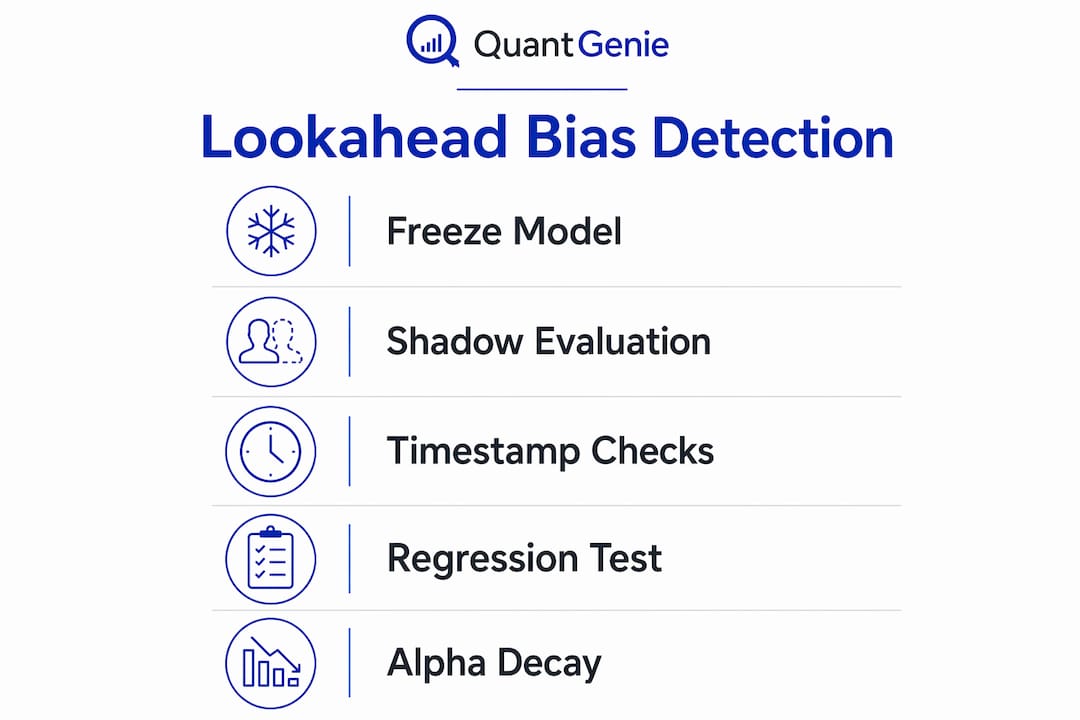
Mitigation is mostly a data-engineering problem, not a modeling problem. Fix the data first.
High-priority fixes:
- Enforce PiT snapshots for all inputs. Every feature must reflect only information that was publicly available at or before the prediction timestamp. Store raw data with both an event timestamp and an
available_attimestamp; never use the event timestamp alone for joins. - Freeze training-data cutoffs. Define a hard cutoff date and enforce it in code. Any data row with an
available_atafter the cutoff must be excluded from training, without exception. - Use temporally consistent splits. Train on data before the cutoff, validate on a buffer period immediately after, and test on data well beyond that. Never shuffle time-series data before splitting.
Data engineering practices:
- Version your datasets with immutable snapshots. A dataset that can be silently updated after training is a contamination risk.
- Use a PiT feature store that stores each feature value alongside the timestamp at which it became available, not the timestamp of the underlying event.
- Apply strict join semantics:
as-ofjoins that match each prediction row to the most recent feature value withavailable_at <= prediction_time.
Model and pretraining strategies:
- Prefer PiT-aware models such as PiT-Inference (Pitinf) variants that enforce temporal cutoffs during pretraining. These show materially smaller alpha decay than standard foundation models.
- Do not rely on prompting or masking to remove memorized content. The weights already contain the information; prompt-level interventions cannot erase it.
Evaluation strategies:
- Use rolling or expanding-window out-of-sample tests. Each fold’s training data must end before the fold’s evaluation data begins.
- Report alpha decay explicitly: P1 alpha, P2 alpha, and the decay metric. A strategy or model with large negative decay should not be deployed.
Pro Tip: Tie lookahead detection checks into your CI/CD pipeline. A backtest or model build should fail automatically when a time-inconsistency is detected, the same way a unit test failure blocks a code merge. This prevents contamination from accumulating silently across iterations.
Research-backed tests and metrics you can actually run
Lookahead Propensity (LAP)
LAP is the core diagnostic from the arXiv work on lookahead bias in LLM forecasts. To compute it, construct a date-only recall query: provide only a firm identifier and a date, no financial context. Extract the model’s first-token probabilities for the positive and negative outcome tokens (P_up and P_down). LAP equals P_up plus P_down. A model with no memorization of that date’s outcome should assign roughly equal probability to both tokens, yielding a LAP near the base rate. A model that has memorized the outcome assigns high probability to the correct token, yielding elevated LAP.
The key diagnostic is the cutoff pattern: LAP should be materially positive inside the training window and collapse near the cutoff date. A sharp drop at a specific date is strong evidence that the model’s in-sample performance was memorization-driven.
The regression interaction test
Augment a standard accuracy regression with two additional terms: LAP itself, and the product of LAP and the model’s forecast. A positive coefficient on the interaction term indicates that the model’s predictive power is concentrated in observations where LAP is high, meaning the model performs well precisely where it has memorized the outcome. That is the contamination signature.
Alpha decay
Alpha decay measures how much a model’s apparent edge shrinks when moved from memorized to out-of-sample data. Compute P1 alpha (performance inside the training window) and P2 alpha (performance outside it). The decay metric is P1 minus P2.
| Model type | P1 alpha (in-sample) | P2 alpha (post-cutoff) | Alpha decay |
|---|---|---|---|
| Standard LLM (memorized) | High | Near zero or negative | Exceeds -15 pp |
| PiT-trained model (Pitinf) | Moderate | Moderate | Substantially smaller |
The table reflects the pattern documented in Look-Ahead-Bench. PiT models do not necessarily outperform standard models in-sample; they simply do not collapse out-of-sample.
Key inputs you need to run LAP:
- Model access to first-token log-probabilities (most API-accessible LLMs expose this).
- A list of firm-date pairs with known outcomes, split by training cutoff.
- No access to training data required; the probe works from the outside.
A pre-release checklist you can run before trusting any result
Run these steps in order. Each one is automatable.
- Verify PiT compliance. Assert that every feature column has an
available_attimestamp and that no row’savailable_atexceeds itsprediction_time. Fail the build if any violation is found. - Confirm training cutoff is frozen. Check that the cutoff date is hardcoded or stored in a versioned config file, not derived at runtime from the dataset’s maximum date.
- Confirm temporal split integrity. Assert that the minimum date in the validation set is strictly greater than the maximum date in the training set, and similarly for test versus validation.
- Run the LAP probe (LLM pipelines only). Execute date-only recall queries for a sample of firm-date pairs inside and outside the training window. Flag the build if LAP does not drop near the cutoff.
- Run the freqtrade-style indicator check (backtest pipelines). Compare indicator values computed on partial versus full data. Any indicator whose value changes when future bars are added is forward-looking and must be fixed or removed.
- Run the post-cutoff shadow evaluation. Freeze the model and evaluate it on data strictly after the cutoff. Compute and log alpha decay. Block deployment if decay exceeds your threshold.
- Run the regression interaction test (LLM pipelines). Fit the augmented accuracy regression. Log the interaction coefficient. A positive and statistically significant coefficient should trigger a review.
- Documentation signoff. Record the training cutoff date, the PiT data source version, the shadow evaluation result, and the alpha decay metric in the model card or backtest report. No deployment without this record.
Tools, libraries, and key papers to go deeper
Practical tools:
- freqtrade lookahead-analysis: A built-in command that reruns a backtest with partial data and flags any indicator whose value changes when future bars are included. Documented in the freqtrade framework; no additional installation required if you are already using freqtrade.
- scikit-learn TimeSeriesSplit: The standard time-series cross-validation utility for Python; use it instead of KFold whenever your data has a time dimension.
- PiT-Inference / Pitinf model family: PiT-aware pretrained models that enforce temporal cutoffs during training, documented in Look-Ahead-Bench. Use these as drop-in replacements for standard LLMs in financial forecasting tasks.
- Look-Ahead-Bench GitHub repo: The benchmark suite from the Look-Ahead-Bench paper; contains evaluation scripts, model comparisons, and the alpha-decay computation pipeline.
Papers to read:
- Sarkar & Vafa (2024), A Test of Lookahead Bias in LLM Forecasts (arXiv:2512.23847): the LAP methodology, the regression interaction test, and the date-only recall probe.
- Look-Ahead-Bench (arXiv:2601.13770): the standardized benchmark, alpha-decay results, and PiT model comparisons.
- Lookahead Bias in Pretrained Language Models (OpenReview, Sarkar & Vafa): the pretraining-memorization mechanism and why prompting cannot fix it.
Where to start by role:
- Traders running backtests: Start with the freqtrade-style indicator check and the PiT unit tests. These two steps catch most pipeline-level contamination without requiring model internals.
- ML researchers: Run the LAP probe and the regression interaction test. Read arXiv:2512.23847 for the formal methodology.
- Data engineers: Focus on PiT feature stores,
available_attimestamps, andas-ofjoin semantics. The data layer is where most contamination originates.
Key Takeaways
Lookahead bias is a data-pipeline problem first: enforce point-in-time snapshots and freeze training cutoffs before adjusting any model.
| Point | Details |
|---|---|
| Definition | Lookahead bias enters when any input reflects information unavailable at decision time. |
| Top detection method | Compute LAP via date-only recall queries; a sharp drop at the training cutoff confirms memorization-driven contamination. |
| Alpha decay benchmark | Standard LLMs can show alpha decay exceeding -15 percentage points when moved from memorized to out-of-sample windows. |
| Ratios are not enough | Sharpe and Sortino ratios can look strong under contamination; validate the generation process, not just the output metric. |
| Quantgenie | Quantgenie’s deterministic builds and PiT-friendly backtesting reduce temporal leakage opportunities before deployment. |
Why PiT discipline is the only honest foundation
The uncomfortable truth about lookahead bias is that it rewards you for being wrong. A contaminated backtest produces numbers that feel like confirmation. The strategy looks good, the Sharpe looks great, and nothing in the output tells you the result is fabricated. That is what makes it genuinely dangerous: the feedback loop is broken in the direction of false confidence.
Most teams discover the problem after deployment, when live performance fails to match backtest performance. At that point, the cost is real. The gap between in-sample and post-cutoff alpha is not a statistical curiosity; it is the difference between a strategy you can trade and one you cannot.
The fix is not complicated, but it requires discipline that has to be built into the process rather than applied as an afterthought. PiT assertions in the build pipeline, frozen cutoffs, and mandatory shadow evaluations are not bureaucratic overhead. They are the minimum conditions for trusting your own results. Teams that skip these steps are not saving time; they are borrowing it from a future where live trading reveals what the backtest concealed.
Quantgenie removes the PiT discipline problem from your backtest workflow
Enforcing point-in-time data discipline manually is tedious and error-prone. Quantgenie’s no-code strategy builder handles the structural requirements automatically: deterministic builds mean every backtest run on the same strategy and data produces identical results, eliminating the silent drift that lets contamination accumulate. The platform uses institutional-grade validated market data with consistent temporal indexing, so the join semantics that cause most pipeline-level leakage are handled at the infrastructure level rather than left to individual engineers.
For institutional backtests and repeated CI checks, that infrastructure matters. For a quick single experiment, lightweight manual checks may be enough. But if you are running strategies seriously, or if you need to present backtest results to stakeholders who will scrutinize the methodology, having a platform that enforces PiT discipline by construction is a different category of reliability. Start building and testing your strategy on Quantgenie and see what a clean, contamination-resistant backtest actually looks like.
Useful sources
- arXiv:2512.23847 — Sarkar & Vafa, A Test of Lookahead Bias in LLM Forecasts. The primary source for the LAP methodology, the date-only recall probe, and the regression interaction test. Start here.
- arXiv:2601.13770 — Look-Ahead-Bench: a Standardized Benchmark of Look-ahead Bias in Point-in-Time LLMs for Finance. Contains the alpha-decay results, PiT model comparisons, and the benchmark evaluation scripts. The GitHub repo linked from this paper includes replication code.
- OpenReview: Lookahead Bias in Pretrained Language Models — Sarkar & Vafa. Explains the pretraining-memorization mechanism and demonstrates why prompt-level mitigations are insufficient.
- CAIA: Sharpe & Sortino — Does It Matter? — Empirical comparison of Sharpe and Sortino across more than 2,000 funds; useful context for why ratio choice is secondary to process validation.
- freqtrade documentation — The lookahead-analysis command is documented in the freqtrade framework’s official docs. Search for “lookahead-analysis” in the freqtrade docs site for the current command syntax and flags.
- PiT-Inference / Pitinf model family — Described in Look-Ahead-Bench (arXiv:2601.13770) as an example of a PiT-aware pretrained model that enforces temporal cutoffs. Use as a reference architecture when selecting base models for financial forecasting.
| Resource | Type | What it gives you |
|---|---|---|
| arXiv:2512.23847 | Academic paper | LAP methodology, regression test, recall probe |
| arXiv:2601.13770 | Benchmark paper + GitHub | Alpha-decay results, PiT model comparisons, replication code |
| OpenReview (Sarkar & Vafa) | Conference paper | Pretraining memorization mechanism, prompting limitations |
| CAIA Sharpe/Sortino post | Industry research | Empirical ratio comparison across 2,000+ funds |
| freqtrade docs | Framework documentation | Lookahead-analysis command for backtest pipelines |
| Pitinf model family | Model reference | PiT-aware pretraining architecture for finance LLMs |