
Best Interactive Brokers Alternatives for No-Code Algo Trading

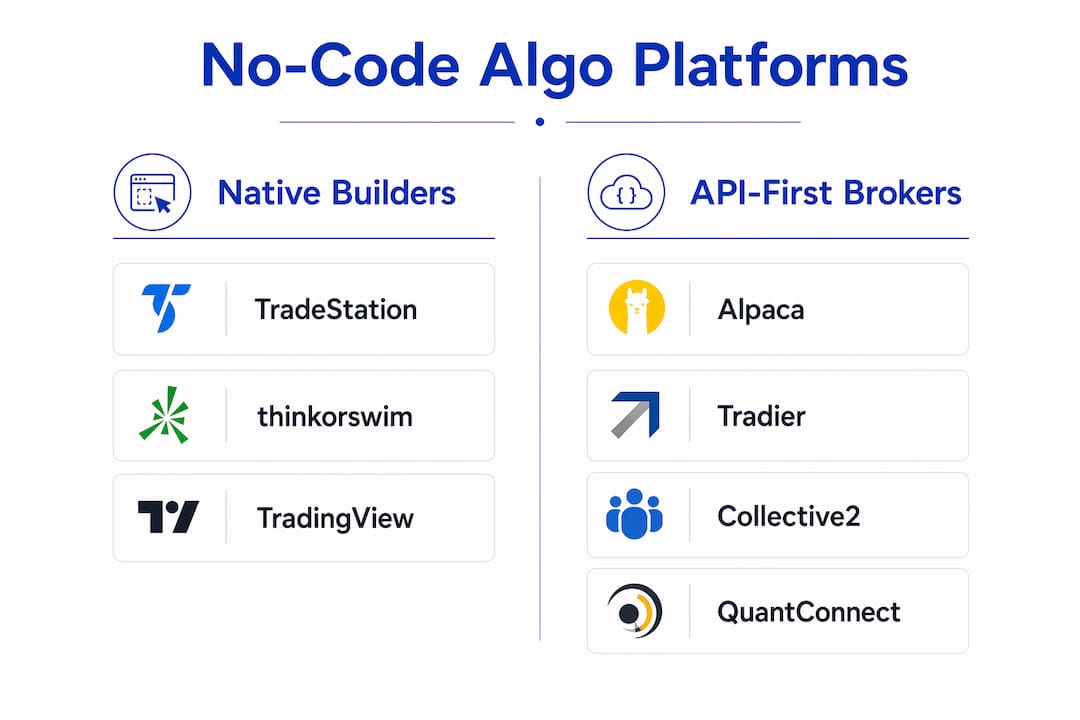
For traders who want no-code algorithm building and simple backtesting without sacrificing market access, the strongest Interactive Brokers alternatives are TradeStation, TD Ameritrade / thinkorswim (now under Charles Schwab), TradingView, Alpaca, Tradier, Collective2, and QuantConnect. Each solves a specific gap IBKR leaves open for non-coders.
Quick verdicts:
- TradeStation — native strategy builder with EasyLanguage, SIPC-covered, strong backtesting
- thinkorswim (Schwab) — visual scripting via thinkScript, deep options tools, FINRA-member, excellent phone support
- TradingView — best charting plus Pine Script; broker integrations let you keep IBKR for execution
- Alpaca — broker API built for automated strategies; no-code front ends connect cleanly
- Tradier — low-cost brokerage API, ideal when you want a clean execution layer under a no-code builder
- Collective2 — strategy marketplace with copy-trading; no coding required to follow or publish algos
- QuantConnect — open-source LEAN engine with a visual layer; institutional-grade historical data
One important note: if IBKR’s execution quality and 150+ market access are working for you, augmenting it with a no-code front end like TradingView or Quantgenie is often the smarter choice than migrating entirely.
Table of Contents
- Which Interactive Brokers alternatives fit no-code algo workflows?
- Short profiles: what each platform actually offers no-code traders
- How to choose the right alternative for your no-code algorithm needs
- Practical migration checklist and testing timeline
- When to augment IBKR versus when to switch entirely
- Key Takeaways
- What actually works in live algo workflows
- Quantgenie: build, backtest, and deploy without writing code
- Useful sources and next-step reading
Which Interactive Brokers alternatives fit no-code algo workflows?
| Platform | Pricing & Fees | Instruments | Algo / No-Code Support | APIs & Integrations | Backtesting Quality | Account Min. | Customer Support |
|---|---|---|---|---|---|---|---|
| TradeStation | $0 stocks/ETFs; options $0.60/contract | Stocks, options, futures, crypto | EasyLanguage strategy builder, visual editor | REST + FIX API | Deterministic, tick-level data | $0 | Phone, chat, email |
| thinkorswim (Schwab) | $0 stocks/ETFs; options $0.65/contract | Stocks, options, futures | thinkScript visual scripting, scan builder | thinkScript API | Strong; intraday + daily data | $0 | 24/7 phone |
| TradingView | Free tier available; paid plans offered | Stocks, forex, crypto, futures | Pine Script; strategy alerts to brokers | 50+ broker integrations | Good; limited tick depth on free tier | $0 (platform) | Email/chat; no phone |
| Alpaca | $0 commissions; margin rates vary | US stocks, ETFs, crypto | No native builder; connects to no-code tools | REST, WebSocket, OAuth | Via third-party integrations | $0 | Email/chat |
| Tradier | $0 stocks; options $0.35/contract | US stocks, options | No native builder; API-first | REST API, webhooks | Via third-party tools | $0 | Phone, email |
| Collective2 | Subscription + performance fees | Stocks, options, futures, forex | Strategy marketplace; no coding to follow | C2 API | Simulated; community-verified | $0 | Email, community forums |
| QuantConnect | Free community access; paid plans available | Stocks, options, futures, forex, crypto | Visual drag-and-drop + LEAN engine | Broker API (Alpaca, Tradier, others) | Institutional-grade; deterministic results | $0 | Community + email |
Three decisive trade-offs worth flagging:
- Fees vs. integrated no-code builders: Zero-commission brokers often offset costs via FX spreads or custody fees — compare total cost, not the headline rate.
- Market coverage: Simpler platforms typically cover fewer exchanges than IBKR’s 150+ markets, which matters for multi-asset or cross-border strategies.
- Copy trading vs. self-directed algos: Collective2 suits hands-off exposure; the others suit builders who want to own their strategy logic.
Pro Tip: If IBKR’s execution and fees are already working, connect TradingView or Quantgenie as a no-code front end via broker API rather than migrating your entire account.
Short profiles: what each platform actually offers no-code traders
TradeStation
TradeStation’s EasyLanguage is the closest thing to a no-code strategy builder that still produces production-ready algos. You describe rules in near-plain-English, the platform compiles them, and backtests run on tick-level historical data. SIPC-covered, SEC/FINRA-registered. The downside: EasyLanguage has a learning curve steeper than a true drag-and-drop tool, and international market access is narrower than IBKR.
Best for: US-focused traders who want a native builder and don’t need global markets.
thinkorswim (Charles Schwab)
After Schwab’s acquisition of TD Ameritrade, thinkorswim remains one of the most capable platforms for options-heavy algo strategies. thinkScript lets you build custom scans, alerts, and automated orders visually. Phone support runs 24/7, which matters when a live strategy misfires at 3 AM. Regulatory coverage: FINRA member, SIPC.
Best for: Options traders who want visual scripting and real human support on call.
TradingView
TradingView’s strength is charting plus community. Pine Script is approachable for non-coders, and the platform integrates with brokers so you can keep IBKR for execution while using TradingView’s interface. The free tier limits historical bars and concurrent alerts. No phone support is the main operational risk during outages.

Best for: Traders who want the best charting experience and are comfortable with email-only support.
Alpaca
Alpaca is a broker API first, not a strategy builder. It shines when you connect a no-code front end (like Quantgenie) to handle strategy logic while Alpaca handles order routing. Commission-free for US stocks and ETFs. The absence of a native visual builder means you need a companion tool.
Best for: Traders who want a clean, programmable execution layer under a no-code builder.
Tradier
Tradier’s $0.35-per-contract options pricing is among the lowest available. Like Alpaca, it is API-first with no native no-code builder, but it integrates cleanly with third-party platforms. Phone and email support available. FINRA member, SIPC-covered.
Best for: Cost-conscious options traders who already have a preferred no-code front end.
Collective2
Collective2 operates as a strategy marketplace where you subscribe to published strategies or publish your own. No coding required to follow a strategy. Community forums and performance track records are public. The trade-off: you are trusting someone else’s logic, and subscription plus performance fees add up.
Best for: Traders who want algo exposure without building anything themselves.
QuantConnect
QuantConnect’s LEAN engine is open-source and institutional-grade. The visual layer and community strategy marketplace reduce the coding burden significantly. Historical data goes deep, and backtests are deterministic. It connects to Alpaca, Tradier, and others for live execution. The community forums are active and genuinely useful for non-coders learning the platform.
Best for: Analysts who want institutional backtesting depth with a growing no-code layer.
Pro Tip: Check each platform’s community forums before committing. Active forums with answered questions from the past 30 days signal a healthy support ecosystem, which is especially valuable when you hit an edge case at 2 AM.
How to choose the right alternative for your no-code algorithm needs
Start with your non-negotiables, then filter by trade-offs.
Must-haves for no-code algo traders:
- Deterministic backtests (same inputs, same results, every time)
- Reproducible historical data sources with documented coverage dates
- One-click or API-based deploy to a live broker account
- Live position monitoring with alerts
- Human support reachable during market hours
Nice-to-haves:
- Strategy marketplace or community templates
- Mobile app with live P&L visibility
- Built-in tax documentation or export
Questions to ask during any trial:
- How far back does your historical data go, and is it survivorship-bias-free?
- What is your average API response latency under peak load?
- What is your SLA for support tickets during market hours?
- Can I run a paper trading account alongside a live account simultaneously?
- Do you provide an audit log of all order submissions and fills?
Red flags that should stop a migration:
- No deterministic backtesting (results vary between runs on the same data)
- Opaque or undocumented data sources
- Ticket-only support with no phone or chat option
- No paper/demo broker environment
- Missing order audit logs
Decision flow:
- Need global markets or futures depth? Keep IBKR; add a no-code front end.
- US stocks and options only, want native builder? TradeStation or thinkorswim.
- Want charting plus broker flexibility? TradingView.
- Want API-first execution under your own no-code tool? Alpaca or Tradier.
- Want hands-off algo exposure? Collective2.
- Need institutional backtesting with a growing visual layer? QuantConnect.
Practical migration checklist and testing timeline
Follow this sequence to avoid disrupting live capital.
- Open a paper/demo account on the target platform and replicate your top two strategies.
- Run parallel backtests on both IBKR’s data and the new platform’s data for the same date range. Flag any divergence above 2% in cumulative return.
- Test customer support by submitting a non-urgent ticket and timing the response. Anything over 24 hours during market hours is a red flag.
- Paper trade for two weeks minimum, tracking fill prices against IBKR’s historical fills for the same signals.
- Fund a small live account (10% of intended allocation) and run the strategy live for one additional week.
- Measure slippage and latency against your paper-trading baseline. If slippage exceeds your backtest assumption by more than your strategy’s average edge, stop.
- Migrate remaining capital only after the live account clears the slippage and P&L gates above.
Operational checks before going live: confirm data feed parity with your existing source, map every order type you use (stop-limit, bracket, trailing stop) to the new platform’s equivalents, and verify margin rules match your position sizing model. Download your IBKR trade history before closing the account for tax documentation.
Pro Tip: Run parallel paper and live tests with synthetic traffic to measure slippage and latency under real-market conditions before shifting meaningful capital. Two weeks of parallel data is the minimum credible gate.
When to augment IBKR versus when to switch entirely
Augment IBKR when:
- Your strategies trade global markets, futures, or instruments most alternatives don’t cover
- IBKR’s execution quality and fee structure are already optimized for your volume
- You only need a better interface or no-code builder, not a new broker
- Regulatory coverage across multiple jurisdictions matters for your fund structure
Switch entirely when:
- You want a native no-code builder tightly integrated with your broker (no API plumbing required)
- Copy trading or a strategy marketplace is your primary workflow
- Simpler tax reporting or local customer support is a genuine operational need
- TWS complexity is causing execution errors, not just friction
Three scenario examples:
- Systematic equity trader, 50 trades/month, US stocks only: Augment. Keep IBKR for execution, connect TradingView or Quantgenie for strategy building and signal generation.
- Options analyst, no coding background, wants visual scripting: Switch to thinkorswim. Native thinkScript, 24/7 phone support, SIPC coverage, no API setup required.
- Passive algo follower, no desire to build: Switch to Collective2. Subscribe to a verified strategy, skip the builder entirely, accept the subscription fee as the cost of delegation.
Professional traders frequently run IBKR for raw market access and a secondary platform for simpler automated strategies — the two-broker setup is common practice, not a workaround.
Key Takeaways
The single most important decision when evaluating IBKR alternatives is whether you need a new broker or just a better no-code front end layered over your existing execution.
| Point | Details |
|---|---|
| Augment before you migrate | Keep IBKR for execution and add a no-code front end if market access and fees already work for you. |
| Deterministic backtests are non-negotiable | Platforms that produce different results on the same data cannot be trusted for live deployment. |
| Total cost beats headline fees | Zero-commission brokers often recover margin via FX spreads or custody fees; compare all-in cost. |
| Test support before you need it | Submit a ticket during your trial and time the response; ticket-only support is a red flag for live strategies. |
| Quantgenie as a no-code layer | Quantgenie translates plain-English strategy descriptions into deterministic algorithms and connects to brokers for live deployment. |
What actually works in live algo workflows
The conventional wisdom says pick one platform and commit. In practice, the traders who avoid the most pain run two accounts: IBKR for anything that needs deep liquidity or global instruments, and a no-code builder for the strategies that don’t require that depth.
The bigger mistake I see is treating a backtest as validation. A backtest is a hypothesis. The real test is whether the platform’s live fills match the backtest’s assumed fills on the same signals, measured over at least two weeks of parallel running. Most platforms pass the backtest comparison. Far fewer pass the live-fill comparison, especially on options or thinly traded names.
One thing that genuinely separates platforms for non-coders: whether the backtest is deterministic. If you run the same strategy twice on the same historical data and get different results, you cannot trust the output. That is not a minor technical detail. It is the difference between a strategy you can defend and one you are guessing about. Quantgenie’s AI-assisted backtest interrogation addresses exactly this, letting you ask plain-English questions about why a backtest produced a specific result before you commit capital.
The human support gap is also underestimated. When a live strategy misfires during a volatile open, a ticket queue is not a support channel. Test it during your trial, not after you’ve migrated.
Quantgenie: build, backtest, and deploy without writing code
If the comparison above clarified what you need from a no-code workflow, Quantgenie maps directly to that need. You describe your strategy in plain English. Quantgenie translates it into a deterministic algorithm, runs it against institutional-grade historical data, and lets you interrogate the results with AI-assisted questions before you deploy a single dollar.
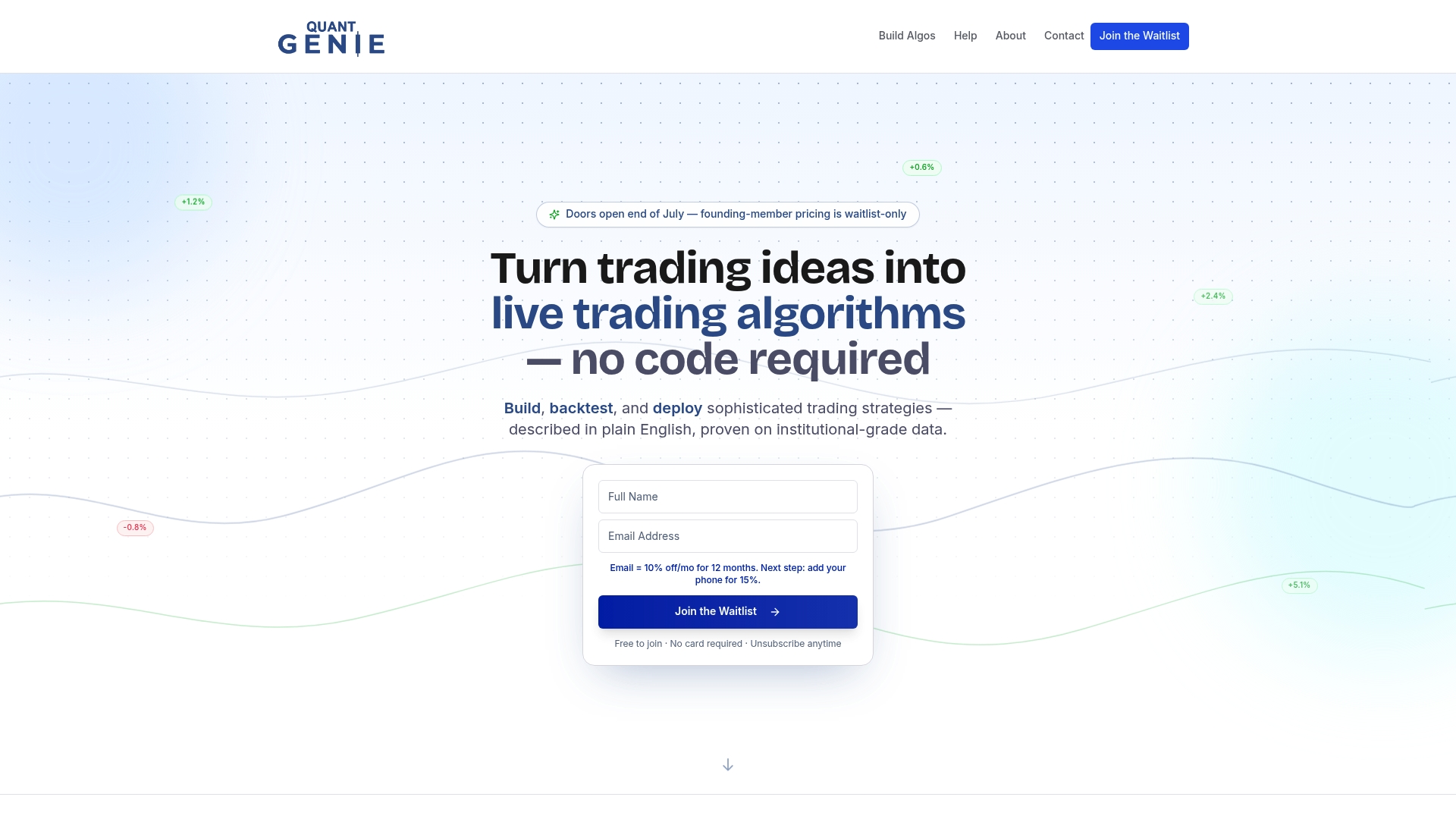
The build-to-deploy path is: describe your strategy, review the backtest with AI assistance, connect your broker account, and go live with full position monitoring. No Python, no API plumbing, no guessing whether the backtest will reproduce. For traders who want to augment an existing IBKR workflow or replace it entirely with a cleaner no-code stack, Quantgenie is worth a trial. Visit quantgenie.ai to explore the platform and start testing your first strategy.
Useful sources and next-step reading
- Best Alternatives to Interactive Brokers in 2026 — newtrading.io: Covers charting platform integrations and US broker alternatives; used for augment-vs-switch and migration guidance.
- Interactive Brokers Alternatives — Zignaly: Market coverage trade-offs, copy trading features, and community marketplace analysis.
- Interactive Brokers Alternatives — Finder: Fee structure breakdowns including hidden costs in zero-commission brokers.
- Best IBKR Alternatives for Global Investing — HeyGoTrade: Professional multi-broker practice and parallel account strategies.
- QuantGenie Platform — quantgenie.ai: Deterministic backtesting methodology, AI-assisted backtest interrogation, and broker integration details; used for regulatory and trust-signal checks on no-code platforms.
- Assymetrix Market Intelligence: Platform and community-driven marketplace analysis relevant to strategy marketplaces and alternative liquidity models.
This article is general information, not financial or investment advice. Confirm current platform terms, regulatory status, and fee structures directly with each provider before making any trading or account decisions.