
Tail Risk Hedging: Strategies for Extreme Market Protection

Tail risk hedging is the deliberate use of strategies designed to protect investment portfolios from rare but catastrophic market events. These are the losses that live in the far left tail of return distributions, the kind that don’t show up in a normal bell curve but have a way of appearing with alarming regularity. Fat-tailed distributions have become more frequent over the past 30 years, with severe market shocks occurring periodically. That’s not a statistical anomaly. That’s a pattern worth building a defense around.
Why does standard diversification fall short when you need it most? Because during genuine tail events, correlations across asset classes tend to spike toward 1. Stocks, credit, and commodities often fall together, stripping away the protection that diversification normally provides. Tail risk hedging addresses exactly this failure mode, using instruments and strategies that are specifically designed to pay off when everything else is collapsing.
Key reasons investors and portfolio managers prioritize downside protection:
- Traditional diversification breaks down during systemic shocks when correlations converge
- Tail events can permanently impair capital, making recovery timelines unacceptably long
- Forced selling during drawdowns locks in losses and destroys long-term compounding
- Institutional mandates and fiduciary standards increasingly require explicit risk controls
- Hedging costs function like insurance premiums: a recurring drag in calm markets, and a lifeline when it matters
The honest framing here is that tail risk hedging is not free, and it is not designed to generate alpha. It is portfolio insurance, and like any insurance, it costs money every year you don’t need it.
Table of Contents
- What are the most effective tail risk hedging strategies?
- Costs, trade-offs, and operational risks you need to understand
- How to integrate tail risk hedging into your portfolio risk management
- How algorithmic tools help you build and backtest tail risk strategies
- Key Takeaways
What are the most effective tail risk hedging strategies?
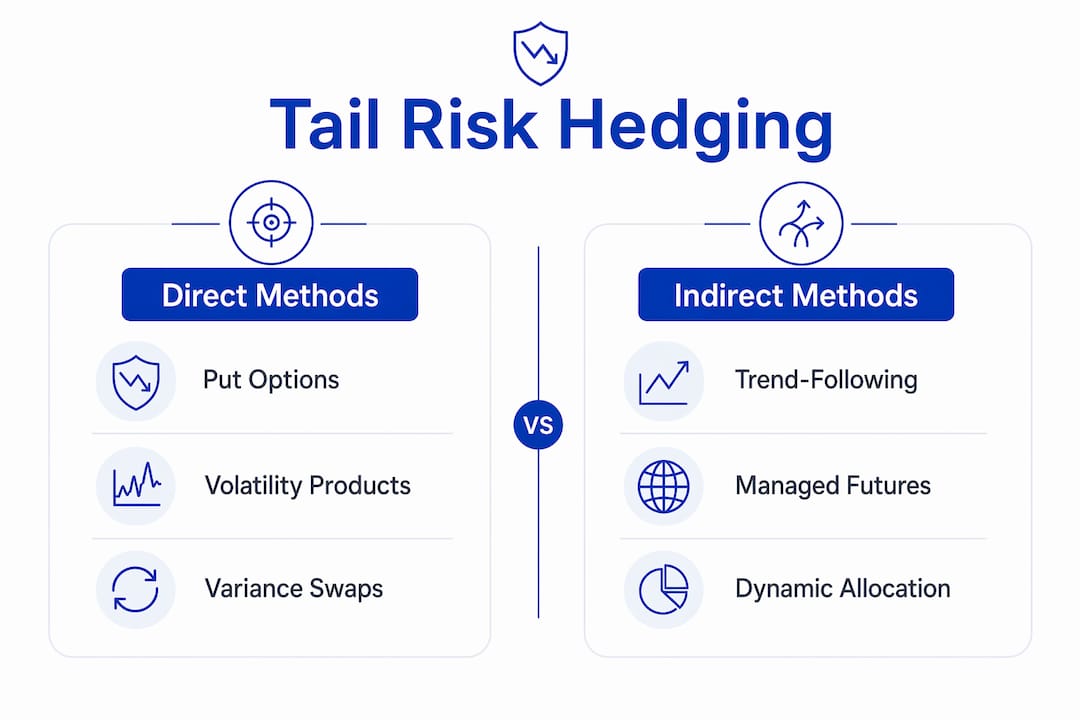
The field splits cleanly into two camps: direct hedges that explicitly pay off during market crashes, and indirect hedges that tend to perform well in crises without being specifically structured around them. Most sophisticated portfolios use both.
Direct hedging methods
Out-of-the-money (OTM) put options on equity indices like the S&P 500 are the most straightforward direct hedge. You pay a premium, and if the market drops sharply, the options gain value. The protection is explicit and quantifiable. The problem is cost. Equity put options drain portfolio returns during normal market years, and many investors abandon the strategy precisely when they should be maintaining it.

Variance swaps and volatility products like VIX call options offer another direct route. These instruments pay off when realized volatility spikes, which almost always accompanies a tail event. Credit default swaps (CDS) on high-yield indices provide protection against credit market dislocations, which often precede or accompany equity crashes. Interest rate options and currency options round out the toolkit for portfolios with significant fixed income or international exposure.
Indirect hedging methods
Trend-following strategies, particularly multi-asset managed futures, have a strong historical track record of performing well during equity market crises. They don’t pay off because they’re structured to, but because sustained market selloffs create the kind of persistent price trends that these strategies are built to capture. AQR research finds that trend-following often correlates positively with crisis periods while avoiding the negative carry of direct put buying.

Long volatility funds and tail risk funds managed by specialized firms take a more systematic approach, combining options overlays with volatility targeting. Gold and long-duration Treasuries have historically served as indirect hedges, though their reliability varies by crisis type. A 2008-style credit crisis is different from a 2022-style rate shock, and the same instruments don’t protect equally well against both.
Key considerations when selecting a tail hedging approach:
- Direct hedges offer explicit, predictable payoffs but carry high premiums and negative carry in benign markets
- Indirect hedges like trend-following have lower drag but may underperform in fast, sharp crashes where trends don’t have time to develop
- Combining both provides more consistent protection across different crisis types and time horizons
- Strike selection for OTM puts matters enormously: too far out-of-the-money and the protection is cheap but insufficient; too close to at-the-money and the cost becomes prohibitive
- Rolling frequency for options-based hedges affects both cost and effectiveness, with monthly rolls generally more expensive than quarterly
Pro Tip: When sizing OTM put positions, consider the portfolio’s specific beta to the index you’re hedging against. A portfolio with concentrated sector exposure may need a different index or a basket of puts to get genuine protection rather than a hedge that looks good on paper.
Costs, trade-offs, and operational risks you need to understand
The single biggest reason investors abandon tail risk hedging is the cost. In a year where markets grind higher, a portfolio carrying put options or long volatility exposure will underperform a naked long portfolio by the full cost of those positions. That drag is real, and it compounds over time.
PIMCO and AQR both emphasize the same point: hedging costs should be budgeted as a long-term portfolio expense, not evaluated quarter by quarter. The investor who drops their hedge after three consecutive years of paying premiums with no payoff is the investor who will be unprotected when the crash finally arrives. This is the behavioral trap that makes tail risk management genuinely hard.
Beyond premium drag, there are operational risks that don’t get enough attention:
- Counterparty risk: OTC derivatives like CDS or bespoke variance swaps carry exposure to the dealer on the other side. During a systemic crisis, that counterparty may be under stress precisely when you need them to perform.
- Liquidity risk: Hedging positions can become trapped when markets seize up. Bid-ask spreads on OTM options can widen dramatically during panics, making it expensive or impossible to exit or roll positions.
- Model risk: Standard option pricing models like Black-Scholes assume normally distributed returns. They systematically underprice fat-tail kurtosis, meaning the options you buy may be mispriced relative to the actual risk you’re trying to hedge.
- Execution risk: Rolling options positions requires active management. Missed rolls or poor timing can leave a portfolio temporarily unhedged at exactly the wrong moment.
- Basis risk: The index you’re hedging against may not perfectly match your portfolio’s actual exposures, leaving residual risk even when the hedge performs as designed.
The misconception that tail risk hedging is “free insurance” because it occasionally pays off big is worth addressing directly. The strategy has a negative expected return by design. You are paying a risk premium to transfer tail risk to a counterparty willing to bear it. That’s the deal, and understanding it upfront prevents the behavioral mistakes that undermine most hedging programs.
How to integrate tail risk hedging into your portfolio risk management
The timing question is where most investors go wrong. Starting hedges after a crisis begins is cost-prohibitive: option premiums spike, volatility sellers disappear, and the protection you need becomes unaffordable. Permanent hedging, budgeted as an ongoing cost, is the approach that actually works.
Think of it this way: a fire insurance policy purchased after smoke appears in the building is not a policy. Tail risk protection works the same way.
Measuring tail risk quantitatively
Before you can hedge, you need to measure what you’re hedging against. The standard toolkit includes:
- Value at Risk (VaR): Estimates the maximum loss over a given time horizon at a specified confidence level. The limitation is that VaR says nothing about the magnitude of losses beyond that threshold.
- Conditional Value at Risk (CVaR): Also called Expected Shortfall, this measures the average loss in the tail beyond the VaR threshold. It’s a more complete picture of tail exposure.
- Stress testing: Running the portfolio through historical scenarios like 2008, March 2020, or the 1987 crash reveals how specific positions behave under extreme conditions.
- Scenario analysis: Forward-looking scenarios (a 30% equity drawdown, a credit spread blowout, a currency crisis) help size hedges appropriately for the risks you’re actually worried about.
Practical integration steps
Embedding tail protection into a portfolio requires more than buying puts. It requires a framework:
- Set a target hedge ratio based on the portfolio’s tail risk budget, not on current market conditions
- Allocate between direct and indirect strategies based on cost tolerance and the specific tail scenarios most relevant to the portfolio
- Establish a rebalancing discipline for options positions, including rules for rolling, adjusting strikes, and managing notional exposure
- Treat the hedge cost as a line item in the investment policy statement, reviewed annually alongside other portfolio expenses
- Monitor basis risk continuously, particularly if the portfolio’s composition drifts from the index being hedged
Regulatory and compliance considerations
Portfolio managers operating under SEC oversight or fiduciary standards face specific requirements around derivatives use. FINRA rules govern the suitability of options strategies for retail accounts, and institutional managers must document their risk management frameworks under Dodd-Frank and relevant SEC regulations. Funds using OTC derivatives face margin and reporting requirements under CFTC rules. Any tail risk hedging program should be reviewed by compliance counsel before implementation, particularly when using leveraged instruments or complex OTC structures.
Pro Tip: Run your tail risk hedging program through a formal Investment Policy Statement review annually. Documenting the rationale, cost budget, and performance benchmarks for the hedge protects both the portfolio and the manager from second-guessing during the inevitable stretches when the hedge is costing money without paying off.
How algorithmic tools help you build and backtest tail risk strategies
The practical challenge of tail risk hedging has always been validation. How do you know your hedge will actually perform when you need it? Historical data on tail events is sparse by definition, and paper analysis of options payoffs doesn’t capture the real-world complexity of rolling positions, managing Greeks, and executing under stress.
Algorithmic platforms that translate plain-English strategy descriptions into deterministic, testable algorithms change this equation. Instead of relying on intuition or simplified spreadsheet models, investors can run their tail hedging logic through institutional-grade historical data, including the 2008 financial crisis, the March 2020 COVID crash, and the 2022 rate shock, and see exactly how the strategy would have behaved.
The key features that matter for tail risk strategy development:
- Natural language strategy input: Describing a hedging rule in plain English and having it translated into a precise, executable algorithm eliminates ambiguity in strategy design
- Deterministic algorithm generation: Every backtest run produces identical results under the same conditions, making it possible to isolate the effect of individual parameter changes
- Historical robustness testing: Running the strategy across multiple market regimes, not just the most recent cycle, reveals whether the hedge is genuinely durable or just optimized for one type of crisis
- Comprehensive performance metrics: Metrics like maximum drawdown, Sharpe ratio, and tail-specific measures like CVaR give a complete picture of how the hedge affects overall portfolio behavior
- Portfolio risk analysis: Seeing how the hedge interacts with the rest of the portfolio, not just in isolation, is critical for sizing and calibration
- Broker integration: Moving from a validated backtest to live deployment without rebuilding the strategy from scratch reduces implementation error
Quantgenie’s no-code platform is built specifically for this workflow. Investors describe their tail risk strategies in plain English, and the platform generates deterministic algorithms that can be backtested against validated market data. The AI-assisted analysis tools let investors interrogate backtest results directly, asking questions about specific drawdown periods or strategy behavior during historical crises, without needing to write a single line of code.
Pro Tip: When backtesting a tail risk hedge, deliberately include the periods when the hedge underperformed, not just the crisis periods where it paid off. A strategy that looks great in 2008 but creates unacceptable drag in 2013 and 2017 may not survive long enough in a real portfolio to deliver its protection when needed.
The combination of expert judgment about which tail scenarios to hedge against and algorithmic rigor in testing and deployment is what separates a well-constructed hedging program from one that looks good on paper but fails in practice.
Key Takeaways
Tail risk hedging works best as a permanent, budgeted portfolio component, not a reactive measure deployed after volatility spikes.
| Point | Details |
|---|---|
| Tail events are more frequent than models suggest | Severe market shocks have occurred with notable frequency over the past decades, far more often than standard bell-curve models predict. |
| Direct and indirect hedges serve different roles | OTM put options provide explicit protection; trend-following strategies offer lower-cost crisis resilience across longer time horizons. |
| Cost is a feature, not a flaw | Hedging premiums function like insurance expenses and should be budgeted annually, not evaluated as strategy failures during calm markets. |
| Permanent hedging outperforms reactive hedging | Option premiums spike when crises begin, making just-in-time protection prohibitively expensive precisely when it’s needed most. |
| Algorithmic backtesting validates real-world durability | Testing tail hedges across multiple historical regimes, including periods of underperformance, reveals whether a strategy can survive long enough to deliver protection. |